

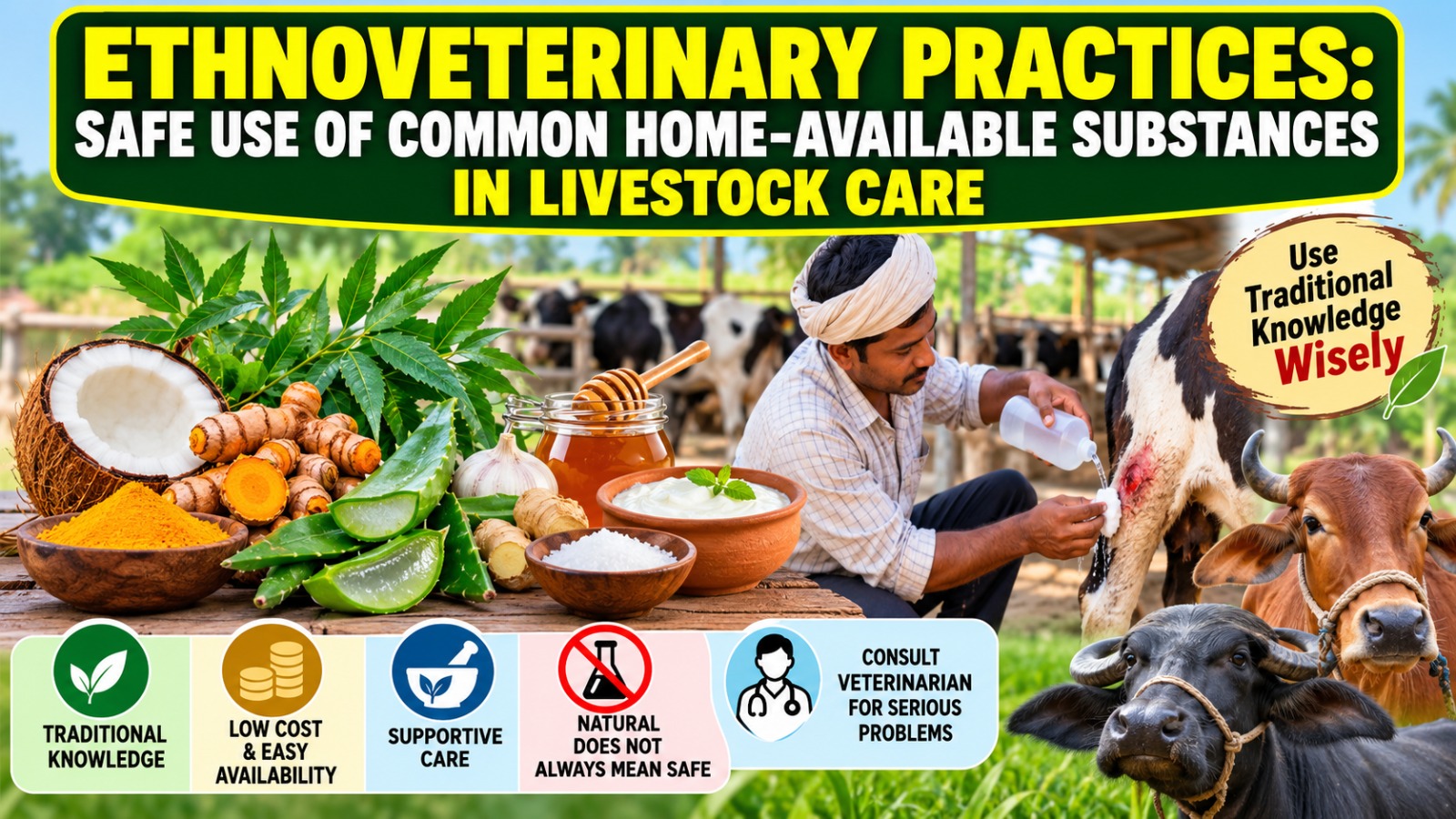
ETHNOVETERINARY PRACTICES: SAFE USE OF COMMON HOME-AVAILABLE SUBSTANCES IN LIVESTOCK CARE
Dr. Supreetkumar Sagar, M.V.Sc., NET, PGDAW1 and Dr. Sanjeev S. Pitlawar, M.V.Sc., PhD, PGDAW2
1: Veterinary Surgeon (Gold medalist), ALUMNUS, College of Veterinary and Animal Sciences, Udgir, Maharashtra Animal & Fishery Sciences University, Nagpur
2: Associate Professor and Sectional Head, Department of Veterinary Surgery and Radiology, College of Veterinary and Animal Sciences, Udgir, Maharashtra Animal & Fishery Sciences University, Nagpur
| FARMER MESSAGE: Traditional remedies can sometimes support basic animal care, but “natural” does not automatically mean safe or effective. Serious disease, poisoning, difficult calving, urinary obstruction, severe mastitis, bloat, fractures and persistent illness require prompt veterinary attention. |
Introduction
Ethnoveterinary medicine refers to traditional knowledge and practices used by livestock keepers to maintain animal health and manage disease using locally available plants, foods, household materials and husbandry methods. In India, such knowledge has been passed from one generation of farmers to another and remains especially relevant where locally available resources form an important part of day-to-day livestock care.
However, traditional knowledge should be used responsibly. Some household substances may be useful for hygiene, nutrition or supportive care, while others may irritate tissues, interact with medicines, contaminate milk or even poison animals. The safest approach is to combine useful traditional knowledge with modern veterinary diagnosis and evidence-based treatment.
Why Farmers Use Ethnoveterinary Practices ?
- Easy availability of materials in rural households
- Low cost and familiarity
- Traditional knowledge within farming communities
- Usefulness for minor supportive care and husbandry
- Reduced dependence on unnecessary medicines when no drug treatment is indicated
Common Household Materials and Their Responsible Uses
| Material | Traditional/Supportive Use | Safer Practical Role | Important Caution |
| Turmeric | Traditionally used in minor skin care | May be used only as a clean supportive topical material on superficial intact/minor skin areas when appropriate | Do not pack into deep wounds, surgical wounds or abscesses; these require examination and proper wound care. |
| Neem | Traditionally used for hygiene and ectoparasite-related practices | Cleaning/environmental hygiene may have a supportive role | Concentrated extracts or oils can irritate or be toxic; do not drench animals with unstandardized preparations. |
| Aloe vera | Used traditionally for soothing skin | Clean, plain gel may have a limited soothing role on minor external irritation | Avoid deep/open wounds and ingestion of unprocessed latex-containing preparations. |
| Coconut oil | Used as an emollient | May help protect dry, unbroken skin | Not a treatment for bacterial/fungal infection or deep wounds. |
| Salt | Used in cleaning solutions and feeding | Correctly prepared saline is useful for gentle wound irrigation; dietary salt is an essential nutrient when rationed correctly | Strong salt solutions damage tissue; excessive dietary salt is dangerous, especially with inadequate water. |
| Sugar/honey | Traditional wound applications | Medical-grade honey has evidence for selected wounds under veterinary supervision | Kitchen honey is not sterile; do not apply to deep or contaminated wounds without veterinary advice. |
| Curd/ fermented feed | Traditional digestive support | Normal safe feed ingredients may support diet palatability in suitable species | Not a substitute for fluid therapy or treatment of severe diarrhoea; spoiled material must never be fed. |
| Ginger/garlic | Traditional digestive or general health remedies | Primarily food/feed ingredients; evidence for treating livestock disease is limited and dose dependent | Large or concentrated amounts can cause adverse effects; do not substitute them for indicated treatment. |
1. Minor Wound and Skin Care
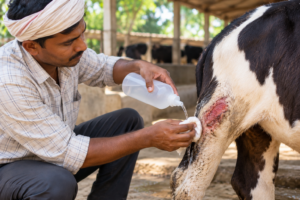
For a fresh superficial wound, the most important first step is cleanliness rather than applying multiple substances. Remove visible dirt gently and irrigate with clean water or appropriately prepared saline. Keep the animal in a clean, dry environment and protect the wound from flies and further trauma.
Deep wounds, punctures, heavily contaminated wounds, wounds near joints, uncontrolled bleeding, maggot infestation or wounds accompanied by fever require veterinary examination. Do not apply chilli, kerosene, diesel, used engine oil, caustic lime, strong disinfectants or other irritants to animal wounds.
2. Digestive Problems and Diarrhoea
Traditional livestock systems use several food ingredients for digestive disturbances, but diarrhoea has many causes including infection, parasites, sudden dietary change and nutritional disease. The immediate priorities are access to clean water, appropriate feeding and prevention of dehydration. Young calves with persistent watery diarrhoea can deteriorate rapidly and may require oral or intravenous electrolyte therapy prescribed according to clinical status.
Do not force-feed oils, herbal mixtures or large volumes of fluid to weak animals or animals unable to swallow normally because aspiration into the lungs can be fatal.
- Bloat: Do Not Depend on Home Remedies
Bloat is distension of the rumen by gas and can become fatal within a short time. A severely distended left abdomen, difficulty breathing, repeated getting up and down, or collapse requires immediate veterinary attention. Traditional oral remedies should never delay emergency decompression and appropriate treatment.
4. Udder and Teat Care
For mastitis prevention, clean housing, clean hands, proper teat preparation, individual towels and post-milking teat disinfection are more reliable than household mixtures. Abnormal milk, clots, a hot painful udder, reduced milk yield or systemic illness should prompt veterinary examination. Do not infuse turmeric, oils, herbal extracts or homemade preparations through the teat canal because contamination can worsen infection.
5. Ectoparasites and Skin Problems
Traditional neem-based practices are common, but skin disease may be caused by ticks, mites, lice, fungi, bacteria or nutritional disorders. Correct diagnosis is therefore important. Environmental cleanliness, grooming and approved veterinary ectoparasite-control products should form the main control programme. Avoid concentrated homemade extracts on damaged skin.
6. Nutritional Support Using Local Feeds
Many locally available feed materials can contribute to animal nutrition when they are safe, correctly identified and incorporated into a balanced ration. Green fodder, good-quality dry fodder, concentrates and an appropriate mineral mixture should be balanced according to species, age, pregnancy and production level. Household ingredients should not replace scientifically balanced mineral supplementation.
Home Care: What Is Reasonable and What Is Not?
| Situation | Reasonable First Step | When Veterinary Help Is Needed |
| Small superficial abrasion | Clean gently; keep dry and protect from contamination | Deep, swollen, painful, bleeding or infected wound |
| Mild temporary appetite reduction | Check feed, water, temperature and environment | Persistent anorexia, fever, pain or weakness |
| Loose faeces | Ensure clean water and assess diet | Young calf, repeated watery diarrhoea, blood, dehydration or depression |
| Minor dry skin | Improve hygiene and investigate irritants | Severe itching, hair loss, crusting or spreading lesions |
| Abnormal milk | Keep milk separate and examine cow | Prompt veterinary evaluation for suspected mastitis |
| Abdominal distension | Treat as potentially serious | Immediate help if bloat is suspected |
Traditional Remedies That Can Be Dangerous
- Kerosene, diesel, petrol or used engine oil applied to skin or wounds.
- Caustic chemicals, concentrated disinfectants or acids/alkalis on living tissue.
- Forceful drenching of a weak, recumbent or poorly swallowing animal.
- Unidentified wild plants or concentrated herbal extracts.
- Large quantities of salt, baking soda, oils or spices without professional advice.
- Homemade preparations introduced into the uterus, udder or teat canal.
- Delaying veterinary treatment for obstruction, poisoning, severe infection, fracture or difficult birth.
| RED-FLAG SIGNS — CALL A VETERINARIAN: inability to stand, breathing difficulty, severe bloat, complete urinary obstruction, persistent high fever, uncontrolled bleeding, suspected poisoning, difficult calving, severe mastitis, repeated vomiting/regurgitation, seizures, fractures, profound dehydration or rapidly worsening illness. |
Seven Principles for Safe Ethnoveterinary Practice
- Identify the problem before attempting treatment.
- Use traditional remedies mainly for low-risk supportive care, not as substitutes for emergency treatment.
- Use only correctly identified, clean and uncontaminated materials.
- Avoid unstandardized concentrated herbal preparations.
- Never introduce non-sterile household substances into body cavities, the udder, uterus or deep wounds.
- Observe the animal closely and stop any remedy if the condition worsens.
- Combine useful indigenous knowledge with veterinary diagnosis, vaccination, deworming, nutrition, biosecurity and modern treatment when indicated.
Ethnoveterinary Knowledge and Scientific Validation
Traditional livestock knowledge is valuable and deserves documentation, but a remedy used for generations is not automatically proven safe or effective. Plant species, preparation method, concentration and dose can greatly alter biological effects. Scientific evaluation is therefore necessary to identify useful remedies, establish safe doses, detect toxicity and determine withdrawal implications for milk and meat.
Farmers and veterinarians can work together to preserve beneficial indigenous knowledge while avoiding practices that cause tissue injury, poisoning, antimicrobial-treatment delay or food-safety problems.
| Farmer gently cleaning a superficial wound with clean water/saline. |
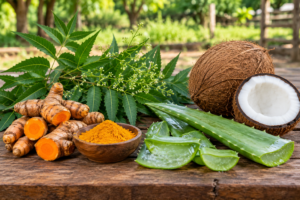
| Photograph of commonly available turmeric, neem, aloe vera and coconut |
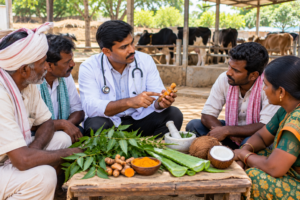
| Veterinarian discussing traditional livestock practices with farmers. |
| Clean livestock housing and hygienic feeding/watering area. |
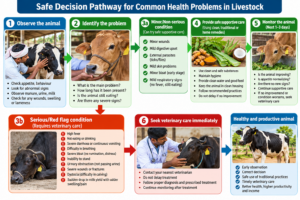
| Figure: Safe decision pathway — Observe animal → Identify minor vs serious problem → Safe supportive care for minor condition → Monitor → Veterinary care if red flags occur. |
| Infographic: ‘Natural does not always mean safe with examples of substances that should never be applied to wounds. |
Conclusion
Ethnoveterinary knowledge is an important part of India’s livestock heritage and can complement good husbandry when used responsibly. Common household materials may have limited roles in hygiene, nutrition and supportive care, but they should not replace diagnosis and effective treatment of serious disease. The best approach is an integrated one: preserve useful traditional knowledge, test it scientifically, avoid hazardous practices and seek veterinary assistance early when an animal shows warning signs.
“Use traditional knowledge wisely—support it with science, hygiene and timely veterinary care.”
Suggested References
- World Health Organization. WHO Global Report on Traditional and Complementary Medicine and related guidance on safe traditional medicine practices.
- Indian Council of Agricultural Research (ICAR). Livestock production, health management and farmer-extension publications.
- National Dairy Development Board (NDDB). Handbook of Good Dairy Husbandry Practices.
- McGaw, L.J. and Eloff, J.N. Ethnoveterinary use of southern African plants and scientific evaluation of medicinal plant applications in animal health.
- Veterinary pharmacology and toxicology texts for assessment of safety, adverse effects and food-animal withdrawal considerations.