
PREVENTION AND MANAGEMENT OF MASTITIS IN HIGH-YIELDING DAIRY COWS
Dr. Supreetkumar Sagar, M.V.Sc., NET, PGDAW1 and Dr. Sanjeev S. Pitlawar, M.V.Sc., PhD, PGDAW2
1: Veterinary Surgeon(Gold medalist), ALUMNUS.,College of Veterinary and Animal Sciences, Udgir, Maharashtra Animal & Fishery Sciences University, Nagpur
2: Associate Professor and Sectional Head Department of Veterinary Surgery and Radiology College of Veterinary and Animal Sciences, Udgir, Maharashtra Animal & Fishery Sciences University, Nagpur
| FARMER MESSAGE: Clean udder + hygienic milking + dry housing + early detection + timely veterinary care = healthier cows and better milk production. |
Introduction
Mastitis is inflammation of the mammary gland and is one of the most important causes of economic loss in dairy farming. High-yielding cows are particularly vulnerable because of frequent milking, greater milk production, udder pressure and increased exposure to infectious and environmental microorganisms. Mastitis can reduce milk yield and quality, increase treatment costs and, when severe or repeated, cause permanent damage to the udder.
Mastitis occurs as clinical or subclinical disease. Clinical mastitis may cause visible changes in the udder or milk, whereas subclinical mastitis often has no obvious signs but can silently reduce production and increase somatic cell count. Therefore, prevention and routine screening are essential components of profitable dairy farming.
How Does Mastitis Develop?
The teat canal is the cow’s first line of defence against microorganisms. Bacteria can enter through the teat canal from contaminated bedding, manure, hands, towels, milking equipment or the surrounding environment. Risk increases when teats are injured, hygiene is poor or cows lie down immediately after milking.
Major Risk Factors in High-Yielding Cows
- Dirty or wet housing and contaminated bedding
- Poor udder and teat hygiene before and after milking
- Improper hand or machine milking technique
- Teat injuries, cracks and chapping
- Poorly cleaned or poorly maintained milking equipment
- Overcrowding, heat stress and inadequate ventilation
- Previous history of mastitis or high somatic cell count
- Poor nutrition and inadequate mineral supply
- Delayed detection and inappropriate treatment
Five Golden Rules for Mastitis Prevention
| RULE | WHAT THE FARMER SHOULD DO |
| 1. Clean cow | Keep udder, teats, bedding and housing clean and dry. |
| 2. Clean milking | Wash visibly dirty teats, disinfect when appropriate, and dry thoroughly before milking. |
| 3. Prevent spread | Use a separate clean towel for each cow and milk healthy cows before suspected/infected cows. |
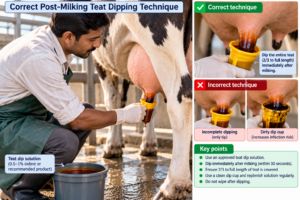
| 4. Protect after milking | Apply suitable post-milking teat disinfectant and keep cows standing for about 30–45 minutes. |
| 5. Detect early | Check foremilk, observe the udder daily and screen high-risk cows for subclinical mastitis. |
Early Detection: Look, Feel and Check
- Udder: swelling, heat, pain, redness, hardness or asymmetry.
- Milk: flakes, clots, watery appearance, blood, abnormal colour or reduced flow.
- Whole cow: fever, depression, reduced appetite or sudden fall in milk production.
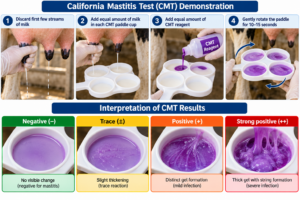
- Subclinical mastitis: use the California Mastitis Test (CMT) or other suitable somatic-cell-based screening methods, especially in high-risk cows.
Management of Mastitis
When mastitis is suspected, contact a veterinarian promptly. Treatment should be based on clinical examination and, when indicated, milk culture and antimicrobial-sensitivity testing. Antimicrobials should not be selected or administered blindly. The veterinarian should determine the appropriate medicine, dose, route and duration.
Milk from treated cows must be withheld for the prescribed withdrawal period. Never mix milk from a treated animal with saleable milk until the withdrawal period has ended.
Severe Mastitis: Treat as an Emergency
Do not squeeze the udder forcefully, inject non-prescribed medicines into the teat, reuse old intramammary tubes, or use leftover antibiotics from another animal. Incorrect treatment can worsen udder damage, delay recovery and contribute to antimicrobial resistance.
Never sell, feed to calves, or mix treated milk into the bulk tank unless this is specifically permitted by the veterinarian and product instructions. The exact milk and meat withdrawal period depends on the medicine, dose, route and product label. Keep a written treatment record for every treated cow.
Important withdrawal-period precautions
In recurrent, severe or herd-level mastitis problems, a representative milk sample collected before antimicrobial treatment can help identify the causative organism and guide therapy. Culture-based treatment can reduce unnecessary antimicrobial use and improve treatment success.
Milk culture and antibiotic stewardship
Supportive care may include adequate clean drinking water, palatable feed, comfortable housing, appropriate anti-inflammatory and pain-relieving medication, and fluid therapy in dehydrated or systemically ill cows. Frequent removal of milk from the affected quarter may be recommended in selected cases to help relieve udder pressure, but the procedure should follow veterinary advice.
Supportive treatment
Systemic antibiotics are not required for every case of mastitis. They are more likely to be considered when there are systemic signs, involvement of deeper udder tissue, multiple affected quarters or other clinical indications. The choice should be based on veterinary assessment and, where appropriate, culture and antimicrobial-sensitivity results.
Systemic treatment
Intramammary preparations are administered directly into the affected quarter through the teat canal. Strict aseptic technique is essential: clean the teat end carefully, use a sterile product and avoid contaminating the applicator. The product, dose and duration should be selected by the veterinarian according to the diagnosis and label instructions.
Intramammary treatment
- Mild clinical mastitis: The affected quarter should be examined and milk should be checked for abnormality. A veterinarian may recommend an appropriate intramammary treatment when indicated, together with suitable supportive care. Milk from the affected quarter should be handled according to veterinary advice and should not enter the saleable milk supply during the applicable withdrawal period.
- Moderate cases: When the cow shows more pronounced udder inflammation or a fall in milk production but remains otherwise stable, veterinary examination is important. Treatment may involve an appropriate intramammary antimicrobial, and systemic therapy may be considered when clinically indicated. Pain and inflammation should also be addressed.
- Severe or toxic mastitis: Cows showing fever, marked depression, dehydration, weakness, severe udder inflammation or collapse require urgent veterinary treatment. Management may include systemic antimicrobial therapy when indicated, intravenous or other appropriate fluid therapy, anti-inflammatory/analgesic treatment and correction of electrolyte or metabolic disturbances. These cases may require hospitalization or intensive monitoring.
Treatment according to severity
Treatment should always be guided by a veterinarian. The objective is to control infection, relieve inflammation and pain, maintain hydration and milk flow when appropriate, and prevent complications and spread within the herd.
Immediate veterinary attention is required when mastitis is accompanied by fever, marked udder swelling or pain, severe depression, dehydration, weakness, abnormal watery milk, loss of appetite or collapse. Severe mastitis can progress rapidly to systemic illness and may threaten the life of the cow.
Dry Period and Early Lactation Management
The dry period provides an important opportunity to protect udder health. Cows with previous mastitis or elevated somatic cell counts should receive special attention. A veterinarian may recommend an appropriate dry-cow therapy and/or internal teat sealant programme based on herd history and individual cow risk.
The first few weeks after calving are also critical. Maintain excellent hygiene, adequate feed and water intake, comfortable housing and close observation of udder health in recently calved high-yielding cows.
Nutrition and Udder Health
A balanced ration according to milk yield, body weight and stage of lactation supports immune function and productive performance. Adequate vitamins and minerals, including appropriate trace minerals, are important for normal immune defence. Supplementation should be based on the animal’s requirements and professional nutritional advice rather than indiscriminate use.
| QUICK FARMER CHECKLIST Before milking: Clean → Disinfect when appropriate → Allow contact time → Dry → Milk During milking: Clean hands → Gentle technique → Correct order → Avoid cross-contamination After milking: Teat dip → Offer feed → Keep cow standing Daily: Observe udder → Examine milk → Keep shed dry → Isolate/manage abnormal cows promptly |
What Farmers Should NOT Do
- Do not ignore abnormal milk or a swollen, hot or painful quarter.
- Do not use leftover antibiotics from another animal.
- Do not stop treatment early without veterinary advice.
- Do not use the same dirty cloth or towel for multiple cows.
- Do not milk infected cows before healthy cows without proper precautions.
- Do not sell or mix milk during the prescribed medicine withdrawal period.
- Do not assume the udder is healthy simply because the milk looks normal; subclinical mastitis may be present.
Practical Mastitis-Control Programme
| Frequency | Activity | Purpose |
| Every milking | Udder/teat hygiene and post-milking teat disinfection | Reduce new infections |
| Daily | Observe udder and foremilk | Early detection of clinical cases |
| Weekly/regularly | Screen high-risk cows using CMT or other suitable tests | Identify subclinical mastitis |
| Regularly | Inspect and maintain milking equipment | Prevent injury and cross-contamination |
| Dry period | Veterinary assessment and appropriate dry-cow programme | Protect udder during dry period |
| After treatment | Follow withdrawal period and reassess response | Protect food safety and animal health |
Suggested Photographs / Illustrations for Magazine Layout
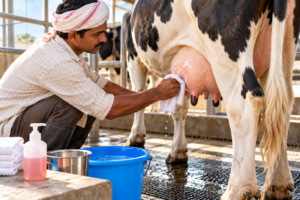
Farmer performing hygienic udder preparation before milking. |
| Correct post-milking teat dipping technique. |
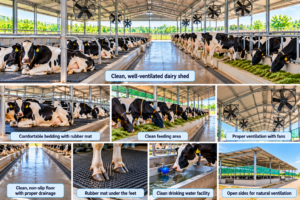
| Clean, dry and well-ventilated dairy shed with comfortable bedding. |
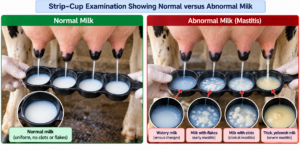
| Strip-cup examination showing normal versus abnormal milk. |
| California Mastitis Test (CMT) demonstration. |
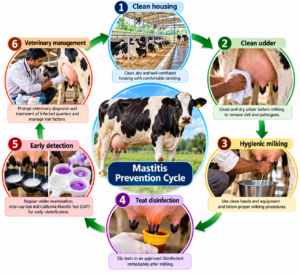
| Figure: Mastitis prevention cycle — Clean housing → Clean udder → Hygienic milking → Teat disinfection → Early detection → Veterinary management. |
Conclusion
Mastitis control is not a single treatment but a continuous farm-management programme. Clean cows, clean udders, clean hands, clean equipment, dry housing, effective teat disinfection, routine screening and timely veterinary intervention can substantially reduce the burden of mastitis. For high-yielding cows, prevention is especially important because protecting udder health directly supports milk production, milk quality, animal welfare and farm profitability.
“Healthy udder today means better milk production tomorrow.”
References
- National Dairy Development Board (NDDB). Handbook of Good Dairy Husbandry Practices. NDDB, Anand.
- Indian Council of Agricultural Research (ICAR). Manual on Management of Gaushalas.
- Gogoi, J. A Look into Bovine Mastitis: Its Pathophysiology and Management. Pashudhan Praharee.
- Indian Farming. Recent approaches to prevention and management of subclinical mastitis and udder health.