

From Tradition to Science: Ethno-Veterinary Approaches and Indigenous technical knowledge to Abortion in Animals
Deepthi V
1st year PhD Scholar, Veterinary Pharmacology and Toxicology, ICAR-IVRI, Izzatnagar, Uttar Pradesh-243122.
Corresponding author: deepthi99v@gmail.com
Abstract
Ethnoveterinary medicine (EVM) embodies the indigenous knowledge, practices and cultural traditions that rural communities have relied upon for centuries to safeguard livestock health. Rooted in oral transmission and experiential learning, EVM encompasses plant based remedies, mineral formulations and ritual practices that remain vital in resource limited settings. However, modernization, generational gaps and lack of systematic documentation threaten its continuity. Scientific validation of EVM is increasingly recognized as essential for bridging traditional wisdom with contemporary veterinary pharmacology. Rigorous phytochemical, pharmacological and toxicological studies have substantiated the efficacy of several ethnoveterinary formulations, highlighting their potential as cost-effective, locally available alternatives to synthetic drugs. Beyond therapeutic value, EVM contributes to sustainable livestock management, reduced antimicrobial dependence and culturally sensitive extension services. Challenges persist in standardizing dosage, ensuring safety and reconciling epistemological divides between traditional healers and scientific communities. Collaborative approaches combining ethnographic documentation, laboratory validation and participatory rural appraisal are vital to preserve and advance this knowledge system. The future of EVM lies in policy inclusion, curriculum integration and translational research that respects cultural heritage while meeting modern standards of evidence. Notably, the contributions of eminent veterinary pharmacologists such as Dr. Natesan Punniyamurthy, honored with the Padma Shri award, underscore the importance of integrating indigenous knowledge into mainstream science. By synthesizing traditional wisdom with modern veterinary pharmacology, EVM can empower rural communities, enrich global pharmacological innovation and strengthen resilient animal healthcare frameworks.
Graphical abstract
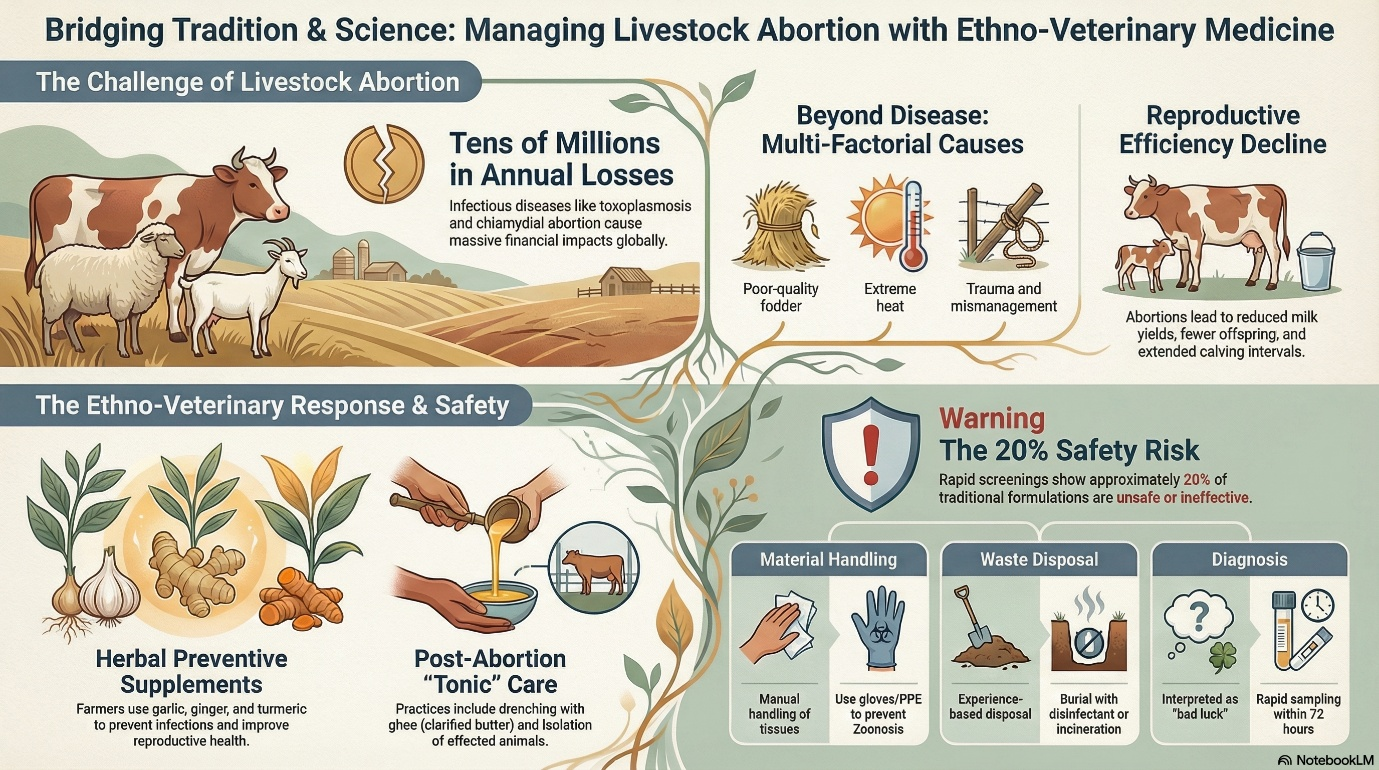
(Created in NotebookLM)
Keywords: Abortion, Ethnoveterinary Practices, Indigenous Knowledge, Sustainable Livestock Healthcare, Veterinary Pharmacology.
1. Introduction
Indigenous technical knowledge (often called local knowledge) is the body of knowledge, skills, technologies, practices and beliefs that local communities develop over generations of living in a particular environment. It is location and culture specific, based on long term observation, experimentation and experience. It guides local level decision making in agriculture, animal health, natural resource management, food, health care and other daily activities. It is usually transmitted orally within communities and continuously adapted through interaction with new conditions (1). In the veterinary context, ethno veterinary medicine is one specialized part of indigenous technical knowledge, specifically focused on the health, care and management of animals using this locally generated knowledge base. It covers not only herbal remedies, but also traditional surgery, immunization, magico religious practices, husbandry methods, breed selection, tools and technologies related to animal health and production (2).
In many low-income and remote regions, veterinary clinics, drugs and trained professionals are either scarce or irregularly available. Rural livestock owners therefore depend on plant based remedies and local practices as their primary health care emergency system. In India, a large share of livestock owners routinely use traditional remedies because modern services are either inaccessible or unaffordable. Conventional veterinary drugs can be costly and often out of stock, while medicinal plants and traditional preparations are both cheap and locally available. Traditional remedies are embedded in local culture and belief systems and are perceived as familiar, trustworthy and often safer than “unknown” pharmaceuticals (3). These systems contain detailed, place specific insights into disease patterns, feeding practices and preventive care that align well with scientific understandings of animal health (4).
2. Abortion in livestock
Abortion is defined as the premature termination of pregnancy with loss of the conceptus after implantation but before the expected full term, resulting in resorption of the embryo (embryonic mortality, “concealed abortion”), maceration or mummification of a dead fetus retained in the uterus or expulsion of a dead or non viable fetus from the uterus (miscarriage/stillbirth). Abortions in livestock cause significant economic and reproductive losses. In cattle, sheep and goats, they reduce productivity by lowering the number of offspring and milk yield, while increasing the proportion of unproductive females. In dairy cattle, late-term abortions are particularly costly, leading to reduced milk production, longer calving intervals and higher culling and replacement expenses. At the national level, infectious abortions such as toxoplasmosis and chlamydial abortion in sheep alone account for losses valued in the tens of millions annually (5).
Reproductively, abortion is a major challenge that lowers fertility indices and offspring output. In small ruminants, it limits production by reducing replacement stock and milk yield, while in cattle, infections like Neospora caninum and brucellosis cause repeated abortions, more services per conception and extended days open, all of which reduce reproductive efficiency (6,7).
At herd or flock level, abortion may occur sporadically or as “abortion storms”, severely reducing productivity. In smallholder systems, this affects livelihoods and food security by reducing meat and milk output and limiting breeding replacements. In endemic regions, repeated abortions due to brucellosis, chlamydiosis or Q fever also pose public health risks and trade barriers, compounding the economic and reproductive impacts across species (5,8).
3. Traditional understanding of abortion causes
Traditional perceptions of abortion determinants in rural livestock systems encompass feed and nutritional constraints such as shortages, poor-quality fodder or spoiled grasses, alongside climatic and stress-related influences including extreme heat, drought and seasonal fluctuations. Infectious etiologies such as brucellosis, leptospirosis or listeriosis are also acknowledged, although knowledge of zoonotic agents remains limited among many farmers. Farmers also attribute abortions to management faults and trauma, including overcrowding, rough handling, fighting and communal grazing practices that spread disease (7,9).
In everyday herd management, abortion is often interpreted as a general sign of poor herd health, bad luck or mismanagement rather than a specific disease. Many smallholders do not seek veterinary help. Therefore, risky practices such as handling aborted material without protection are common. Knowledge is largely experience-based and collective, with herdsmen and elders recognizing seasonal patterns or associations with certain feeds. Reproductive failures are frequently normalized as part of livestock keeping, leading to underestimation of their economic impact (10).
4. Indigenous preventive practices
Indigenous preventive practices against abortion in livestock focus on nutrition, housing, seasonality and herbal remedies, often aligning with scientifically recognized risk factors. Farmers use herbal feed supplements and medicinal plants such as garlic, ginger, fenugreek, turmeric and bitter leaf, which are believed to prevent infections and improve reproductive performance. Plants like Salvadora persica and Vernonia amygdalina are used orally to manage abortion causes linked to brucellosis and other diseases (11).
Nutritional management is a critical determinant of reproductive outcomes. Supplementary feeding during late pregnancy has been shown to significantly reduce abortion risk, whereas deficiencies in key vitamins and minerals (A, D, E, Ca, P, Cu, Se, I, Zn) are recognized as important contributing factors. Farmers adapt their management practices seasonally, adjusting grazing regimes and supplementing diets with crop residues or stored fodder during high-risk periods such as drought or cold seasons (12).
Other preventive measures include housing pregnant animals at night, careful storage of feed to avoid spoilage, in addition to household-level rituals or traditional remedies. These strategies are community based and experience driven, and they often prove effective when they align with established biological risk factors (13).
- Ethnoveterinary approaches to post abortion care
Traditional post abortion care in rural livestock systems relies on household remedies, simple management modifications and community based strategies rather than intensive veterinary treatment. Farmers often practice isolation, culling or selling aborted animals to reduce disease risk and mitigate economic losses, particularly in brucellosis endemic regions. Community-based strategies emphasize separating affected animals, safe disposal of aborted tissues (fetuses, placentas) and farmer education through local leaders (14).
At the household level, feeding changes and supportive care are common. In India, many farmers drench ghee (clarified butter) for a few days after abortion as a tonic, alongside resting animals and adjusting concentrate feeding. Herbal and fatty preparations are embedded in broader ethnoveterinary systems, using oils, grains and medicinal plants for uterine cleansing, expulsion of membranes and restoring reproductive function (15).
Community based management includes collective discussions and planning around abortion related diseases, with steps such as isolation, culling, calf vaccination and reporting. However, many farmers self treat using purchased drugs or traditional remedies without veterinary consultation, shaping how abortions are managed and reported.
6. Medicinal plants used in reproductive health
Medicinal plants are widely used in rural livestock systems to support pregnancy, prevent complications and aid recovery after reproductive problems, though most evidence remains descriptive rather than scientifically validated. Farmers employ a variety of herbs to strengthen the uterus, improve fertility and reduce pregnancy loss in cattle, buffalo, sheep and goats. In smallholder systems, plants like Elephantorrhiza elephantina and Rhoicissus tomentosa are used to restore fertility in goats, while polyherbal mixtures of fenugreek, ginger, turmeric, fennel and cumin have been shown to improve immunity, uterine cleansing, and faster resumption of cycles in postpartum buffaloes (16). Traditional Chinese herbal powders containing species such as Leonurus and Angelica are also reported to enhance fertility after retained placenta in dairy cows (17).
Preparation methods are simple and consistent across studies: decoctions are most common, followed by powders and infusions, using mainly leaves and roots. Remedies are usually administered orally, either as drinks, drenches or mixed into feed and often involve mixtures of multiple plants to maximize perceived synergistic effects.
7. Ritual and non-medicinal indigenous practices
Ritual and nonmedicinal indigenous practices form a cultural backbone of animal healthcare, complementing herbal remedies with customs, beliefs and handling norms. These practices emphasize respect, reciprocity and symbolic relations with animals and nature. For example, among Mapuche campesinos, plants are treated as living beings with spirits and permission is asked before collecting them. In Andean and Latin American contexts, animal care carries symbolic and religious meaning, with sheep in Chiapas considered sacred and cows in Nepal viewed as divine, shaping expectations of special care (18,19).
Everyday handling practices also reflect cultural rules: farmers combine technical actions like separate birthing areas or vaccination with moral ideals of being a “good farmer.” Traditional lay meat inspection examining organs at slaughter shows cultural competence in disease recognition even without formal veterinary oversight (20).
These non medicinal practices highlight the cultural dimension of ethnoveterinary medicine, where beliefs and symbolic frameworks guide how remedies are chosen, how animals are treated and how communities engage with veterinary services. Traditional and biomedical systems often coexist, with vaccines and pharmaceuticals adopted but interpreted within local concepts of luck, respect and ritual order.
8. Scientific validation of indigenous knowledge
Scientific validation of indigenous ethno veterinary knowledge is essential because, while traditional remedies are widespread, affordable and often perceived as effective, most have not been rigorously tested. Surveys document dozens of plants and hundreds of formulations, but only a small fraction have undergone proper phytochemical, pharmacological and antimicrobial evaluation. Consequently, critical questions regarding efficacy, safety, dosage and toxicology remain unresolved. Although some plants demonstrate promising antimicrobial or anti inflammatory effects, they may also exhibit toxicity at high doses, underscoring the need for careful dose-response studies.
Validation approaches such as rapid safety-efficacy screening, Quantification of Indigenous Knowledge (QuIK) and reverse pharmacology help separate effective practices from harmful or ineffective ones (21). Rapid assessments have already shown that about 20% of formulations are unsafe or ineffective, underscoring the importance of screening. For life-threatening diseases like rabies, controlled experiments reveal no effective traditional remedy despite high perceived success, illustrating the risks of relying on untested practices (22).
9. Public health and biosecurity concerns
Abortion in livestock is not only an economic concern but also a public health and biosecurity risk, since many causes are infectious and zoonotic. Pathogens such as Brucella spp., Coxiella burnetii (Q fever), Leptospira spp., Campylobacter spp., Toxoplasma gondii, and Chlamydia abortus are frequently detected in aborted fetuses and tissues, sometimes in mixed infections. These agents pose high transmission risks to farmers, families, veterinarians and slaughterhouse workers during abortion events (23).
Diagnosis and surveillance are critical. Rapid sampling within 72 hours improves diagnostic success, and safer sample types (vaginal swabs, placental swabs, fetal tongue, selected organs) enable molecular testing without the need to handle whole carcasses. Surveillance systems help detect emerging pathogens and guide control or vaccination strategies (24).
Hygiene and safe disposal are equally important to break transmission routes. Farmers are advised to use gloves or other personal protective equipment when handling aborted material, promptly remove fetuses and placental tissues to limit contamination, dispose of them safely through burial with disinfectant or controlled incineration and disinfect contaminated areas to prevent further spread.
10. Integration of tradition with modern veterinary science
Bringing indigenous knowledge and modern veterinary science together requires a collaborative approach where farmers and tribal healers practices are documented, appraised, and validated scientifically. Veterinarians can systematically document traditional remedies through structured interviews, ethnobotanical surveys and participatory rural appraisal, with careful recording of preparation methods, dosage regimens and routes of administration. Tools such as Relative Frequency of Citation and Informant Consensus Factor help identify widely trusted remedies, while participatory methods like Farmer Participatory Research and Quantification of Indigenous Knowledge allow farmers to evaluate practices alongside modern drugs (25). Reverse pharmacology then links promising remedies to laboratory and clinical testing to clarify mechanisms, dosage and safety.
Participatory engagement fosters trust, enhances the accuracy of disease reporting and ensures that interventions are culturally appropriate and contextually aligned. In tribal and pastoral areas, involving local communities empowers them, preserves valuable knowledge and produces hybrid solutions that blend biomedical and ethnoveterinary methods. Ultimately, integration depends on veterinarians working with communities rather than over them, cocreating validated practices that enhance animal health services while safeguarding indigenous knowledge.
11. Challenges in documentation
Ethnoveterinary knowledge is rich but fragile, facing multiple challenges in documentation and preservation. Much of it is transmitted orally and concentrated among elders, making it vulnerable to loss through aging, death or memory decline. Younger generations often dismiss traditional practices as outdated or unscientific, preferring modern drugs, which reduces interest in learning and passing on remedies. Modern education, the prestige of Western medicine, environmental changes and the disappearance of medicinal species further erode this knowledge base. In many communities, remedies are kept secret within families to protect status or income, limiting wider transmission.
Documentation is hindered by the lack of written records, low literacy and linguistic diversity across regions, making systematic recording difficult. Where inventorization has begun, it is often late and partial. Standardization poses another challenge: remedies vary widely by healer, village and ethnic group, with differences in plant mixtures, preparation methods, doses and treatment duration. Dosages are rarely quantified, toxicity limits are unclear and diverse cultural beliefs embed practices that may not be scientifically effective (26).
12. Conclusion
Future directions for ethnoveterinary knowledge emphasize moving from fragile oral traditions toward systematic recording, integration into education and supportive policy frameworks. Researchers highlight the urgent need to build databases of indigenous practices, digitizing remedies, plants, preparation methods and diseases treated. These repositories not only preserve knowledge concentrated among elders but also create pipelines for pharmacological testing and conservation planning.
Education is another priority: ethnoveterinary content is largely absent from formal curricula, leaving graduates unprepared to engage with farmers practices. Recommendations include establishing research labs dedicated to indigenous animal health, training veterinarians to treat ethnoveterinary knowledge as legitimate and incorporating community based modules into veterinary programs.
Policy support is equally critical. Reviews call for pharmacological and toxicological testing of widely used plants to enable safe integration into mainstream services. Proposed directions include recognizing ethnoveterinary medicine in national livestock and biodiversity strategies, supporting community based conservation of medicinal species and adopting bottom up approaches that respect cultural realities while ensuring fair benefit sharing.
13. References
- Swanepoel D, van der Westhuizen E. African indigenous knowledge: Dissemination of IK related information in the Onderstepoort Veterinary Institute Library and the Jotello F. Soga Library, Faculty of Veterinary Science, University of Pretoria. 2009.
- Oyda S. Review on traditional ethno-veterinary medicine and medicinal plants used by indigenous people in Ethiopia: practice and application system. Int J Res. 2017;5:109–19.
- Meena D, Chadda A, Priyanka B, Kant A. Ethno-veterinary practices used for animal health care management: A review. Indian J Anim Health. 2024;63(1):01–9.
- Vogl CR, Vogl-Lukasser B, Walkenhorst M. Local knowledge held by farmers in Eastern Tyrol (Austria) about the use of plants to maintain and improve animal health and welfare. Journal of Ethnobiology and Ethnomedicine. 2016;12(1):40.
- Ramo M de los A, Benito AA, Quílez J, Monteagudo LV, Baselga C, Tejedor MT. Coxiella burnetii and co-infections with other major pathogens causing abortion in small ruminant flocks in the Iberian Peninsula. Animals. 2022;12(24):3454.
- Villa L, Gazzonis AL, Fumagalli E, Zanzani SA, Manfredi MT. The utility of serological analysis for Neospora caninum infection in dairy cattle farms management: serological investigation and evaluation of the effects on reproductive and productive performances in two study herds in Northern Italy. Animals. 2022;12(6):786.
- Robi DT, Gelalcha BD, Deresa FB. Knowledge and perception of community about causes of cattle abortion and case‐control study of brucellosis as cause of abortion in Jimma zone, Ethiopia. Veterinary Medicine and Science. 2021;7(6):2240–9.
- Malal ME, Turkyilmaz S. Identification and genotyping of Chlamydia abortus with MLVA from ruminant abortions in the Marmara region of Turkey. The Thai Journal of Veterinary Medicine. 2021;51(1):169–75.
- Gelalcha BD, Robi DT, Deressa FB. A participatory epidemiological investigation of causes of cattle abortion in Jimma zone, Ethiopia. Heliyon. 2021;7(8).
- Alemayehu G, Mamo G, Desta H, Alemu B, Wieland B. Knowledge, attitude, and practices to zoonotic disease risks from livestock birth products among smallholder communities in Ethiopia. One Health. 2021;12:100223.
- Robi DT, Bogale A, Temteme S, Aleme M, Urge B. Using participatory epidemiology to investigate the causes of cattle abortion in Southwest Ethiopia. Heliyon. 2024;10(4).
- Sadri H, Khordadmehr M, Akbari H, Shirazi J, Jafari-Khataylou Y, Eskandari S, et al. Nutritional deficiencies and abortions in sheep and goats: An in-depth study from East Azerbaijan Province, Northwest Iran. Plos one. 2025;20(8):e0327768.
- Robi DT, Bogale A, Temteme S, Aleme M, Urge B. Using participatory epidemiology to investigate the causes of cattle abortion in Southwest Ethiopia. Heliyon. 2024;10(4).
- Asakura S, Makingi G, John K, Kazwala R, Makita K. Use of a participatory method for community-based brucellosis control design in agro-pastoral areas in Tanzania. Frontiers in Veterinary Science. 2022;9:767198.
- Verma HC, Singh KD, Verma MK, Kumar S, Kumar A, Kumar R. Indigenous Traditional Knowledge Used for Reproductive Disorders and Constraints Faced by Small Dairy Farmers. The Indian Journal of Animal Reproduc tion. 2025;46(1):33–8.
- Rwodzi M. Alternative remedies used by resource-limited farmers in the treatment and manipulation of the reproductive system of non-descript goats in the Eastern Cape Province, South Africa. 2014.
- Huang X, Wang S, Wang L, Wang H, Li X, Cui D. Administration of an herbal powder based on traditional Chinese veterinary medicine enhanced the fertility of Holstein dairy cows affected with retained placenta. Theriogenology. 2018;121:67–71.
- Olivares F, Marchant C, Ibarra JT. “The climate itself must have hidden some medicines”: traditional veterinary medicine of indigenous and non-indigenous campesinos of the southern Andes. Journal of ethnobiology and ethnomedicine. 2022;18(1):36.
- Pun M, Bhatt BR, Shah S, Neupane N, Kaphle K. Cattle Reproductive Disorders Documented from Gaushalas of Nepal. Veterinary medicine international. 2024;2024(1):3058386.
- Falla-Tapias S, Sierra-Barón W, López-Santamaria E, Botero-Aldana D, Burgos-Paz W. Social Representations of Animal Health and Welfare in Rural Colombia: Implications for Sustainable Livestock Farming. Sustainability. 2025;17(11):5168.
- Meena DC, Meena B, Garai S, Sankhala G. Participatory evaluation of ethno-veterinary livestock health practices byfarmers from surrounding villages in Ranthambore Tiger Reserve, India. 2023.
- Beasley EA, Wallace RM, Coetzer A, Nel LH, Pieracci EG. Roles of traditional medicine and traditional healers for rabies prevention and potential impacts on post-exposure prophylaxis: A literature review. PLoS Neglected Tropical Diseases. 2022;16(1):e0010087.
- Şevik M. Zoonotic Abortifacient Agents in Bovine Abortion: Diagnostic Assessment of 125 Cases (2015‐2017). Veterinary Medicine and Science. 2025;11(3):e70354.
- Lankester F, Kibona TJ, Allan KJ, de Glanville W, Buza JJ, Katzer F, et al. Livestock abortion surveillance in Tanzania reveals disease priorities and importance of timely collection of vaginal swab samples for attribution. Elife. 2024;13:RP95296.
- Wani ZA, Farooq A, Sarwar S, Negi VS, Shah AA, Singh B, et al. Scientific appraisal and therapeutic properties of plants utilized for veterinary care in Poonch district of Jammu and Kashmir, India. Biology. 2022;11(10):1415.
- Mandal SK, Rahaman CH. Inventorization and consensus analysis of ethnoveterinary medicinal knowledge among the local people in Eastern India: Perception, cultural significance, and resilience. Frontiers in Pharmacology. 2022;13:861577.