

Homeopathy in Bovine Mastitis: An Emerging Alternative for Sustainable Dairy Health
DR. TARINI NAIK,Veterinary Assistant Surgeon, Government Cattle Breeding Farm Anjora, Durg, Chhattisgarh
Abstract
Mastitis is an inflammatory process in the tissues of the mammary gland and and it is one of the major illnesses that affect dairy herds leads to financial loss. Although antibiotics are the most common way to treat mastitis but due to the increase incidence of antibiotic resistance and potential for milk residues required an alternative substitutes to promote both animal and food safety. Homeopathy is an alternative system of medicine which relies on the principle of like cures like and obtained from plants, animals and minerals with the help of dilution process . Various types of mastitis respond to homoeopathic medicines. The future integration of homeopathy into veterinary practice, along with selective dry cow therapy, enhanced hygiene practices, adequate nutrition and management protocols helps in improving cure rates and reduce economic losses, and ensure sustainable dairy production.
Key words: Mastitis, homeopathy, antibiotic resistance, food safety
Mastitis is an inflammation of the mammary gland, primarily caused by bacterial infections. It not only reduces the milk quantity but also alters the milk quality leading to significant economic losses in dairy farming. In addition to reduced productivity, treatment costs, and discarded milk, mastitis also requires increased labor and culling of affected animals (Li et al., 2023). Common symptoms of mastitis in cows and buffaloes include: painful and swelling of udder, reduce milk yield, heat and redness of udder, milk may appear watery or contain clots, loss of appetite and sometimes animal may reluctant to move. Tomanić et al., 2023 reveal that mastitis is associated with more than 140 microorganisms; the leading bacterial pathogens that cause mastitis are Staphylococcus aureus, Streptococcus agalactiae, Escherichia coli, and Streptococcus uberis .
Treatments for bovine mastitis include antibiotic therapy like penicillin, tetracycline, ampicillin, gentamycin, etc., are given in combination with nonsteroidal anti-inflammatory medicines (NSAIDs) and other systemic anti-inflammatory compounds. These combination of treatment help in health of animals by lowering inflammation. With rising concerns of antibiotic resistance and human health due to antibiotic residues in milk alternative treatment options is required. Homeopathy is emerging as the main alternative to antibiotic therapy. Homeopathic remedies aims is to prevent the recurrence of diseases, also homeopathic remedies have low cost and do not leave medicinal traces in meat and milk.
Causes and Pathogens
Mastitis is typically caused by bacterial infections, but several other factors also contributes:
1.Bacterial infection- Staphylococcus aureus, Streptococcus agalactiae, E. coli, Streptococcus uberis, Mycoplasma
- Poor milking hygiene, teat Injuries, rough handling, or machine milking, contaminated bedding, around the udder.
- Incomplete Milking
- Blocked teat canal and previous infections or anatomical defects.
Pathogenesis.:
The pathogenesis of clinical mastitis begins when pathogens penetrate and enter the teat canal and mammary gland, they trigger an immune response. They then multiply and trigger a local immune response characterized by the recruitment of polymorphonuclear neutrophils (PMNs), release of interleukin-1 (IL-1) and tumor necrosis factor-alpha (TNF-α), and an increase in somatic cell count (SCC). Body responds with inflammation, characterized by increased blood flow and the influx of immune cells on the site of infection which lead to swelling, pain, and changes in milk composition, including increased somatic cell counts. Virulence factors, such as Escherichia coli lipopolysaccharides (LPS) for endotoxemia and biofilms in Staphylococcus aureus, contribute to persistence and severity (Oliveira et al., 2011, Rainard et al., 2018).
Risk factors
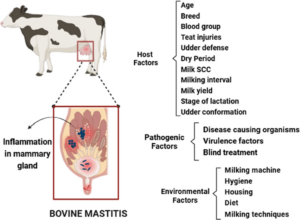
Involvement of different risk factors in the development of mastitis in bovine is presented in figure 1.
Figure 1 Source- Teotia et al. (2025)
Types of Mastitis:
- Clinical Mastitis: Characterized by visible signs such as redness, swelling, heat, and pain in the udder, along with changes in milk color, consistency, and odor, subsequently reduced milk production.
- Subclinical Mastitis: No visible signs in the udder or milk, but laboratory tests reveal increased somatic cell counts, indicating infection. Increased somatic cell counts (SCCs), detectable via the California Mastitis Test or automated SCC testing. SCC ≥ 200,000 cells/mL indicates a high level of infection.
3.Peracute Mastitis: Sudden onset with high fever and toxemia, and some times causes death due to bacteremia.
- Acute Mastitis: Rapid onset of clinical signs with fever, inflammation, and milk changes but less than peracute form.
5.Sub-acute Mastitis: Mild udder and milk changes without systemic signs like fever or toxemia.
6.Chronic Mastitis: Persistent infection without obvious clinical signs, often leading to elevated somatic cell counts and increased risk of re-infection.
Homeopathy remedies in bovine mastitis
Homeopathy is based on three principles: the similia principle, drug testing and dilution of doses, which were developed by the German doctor Samuel Hahnemann. Homeopathic medicine is an alternative system of medical based on the “like cures like,” principle, using highly diluted substances which helps in stimulating the body’s self-healing process. Striezel (2001) considered homeopathy as a regulatory therapy, which promotes healing process by stimulating the individual immune system and regulating the body metabolism. Homeopathic treatment is bsed on symptoms and type of mastitis . The most commonly used remedies include:
Belladonna- Belladonna is a very useful homeopathic medicine for mastitis. It works well in the initial stage of inflammation and best for acute form of mastitis with sudden onset. Symptoms includes swollen, hot, red udder, high fever and throbbing pain.
Phytolacca decandra– It is best for chronic mastitis. Symptoms include hard knots in udder and milk becomes thick or curdled.
Bryonia Alba– Bryonia is an excellent homeopathic treatment for mastitis. Its use is considered to be well in cases of mastitis when the udder are stony hard. Best for hard, painful dried swollen udder. Symptoms includes animal becomes reluctant to move due to pain.
Conium Maculatum– Used in Chronic and repeated infections of mammary gland. Symptoms include hardening of the udder.
Silicea– It is very effective homeopathic medicines for mastitis when treating with suppurative conditions. It help in the drainage of pus without any surgical intervention. Best for suppurative or abscess-forming mastitis. Symptoms include abscess pointing, pus discharge and in recurrent infections.
Hepar sulphuris– is also effective in mastitis with formation of pus. Symptoms includes painful, sensitive udder; foul-smelling pus.
Arnica montana – Best for traumatic injuries of udder due to fall or while in transit. Symptoms include bruised feeling of the udder.
Sulphur– Effective in chronic and neglected mastitis with dryness. Symptoms includes hot and dry udder.
Discussion
Vijay and Inbaraj (2025) observed that use of homeopathy medicine – Belladona, Bryonia, Conium, Carb animalis, Phytolacca, Sulphur, Silecea, and carbo veg. mixed together in 200c potency (each) helps in reducing udder swelling significantly. The MESTEAT liquid contains Belladona 3X, (5 ml); Chamomila 3X (5 ml);
Mercurius Solubilis 3X (2 gms); Phytolacca 2X (5 ml) and Silicea 3X (2 gms). The MESTEAT liquid was given orally @5ml, 3 times, daily for about 2 months. After two months, the CMT score was recorded which showed negative result indicating complete elimination of infection and full recovery in Rathi cattle (Johri and Baberwal, 2024). The combination of Phytolacca, Calcarea fluorica., Silica, Belladonna, Bryonia, Arnica, Conium and Ipecacuanha (Healwell VT-6) was effective and economical in the management of mastitis in lactating dairy cows. (Varshney and Naresh, 2005).
Kumar (2020) used homeopathic remedies Conium maculatum 200c, Carboanimalis 200c and Silicea 200c to treat fibrosis in cows. Day (1992) reported that Silicea stimulates expulsion of foreign body from tissues in chronic low-grade inflammations. Conium maculatum acts on glandular system causing engorgement and indurations by altering the structure (Madrewar 1996).
Boericke (1969) has prescribed Phytolacca (200X German Tincture) for mastitis & galactorrhoea. Phytolacca is a useful remedy in case of hard, swollen and stony udder accompanied with curdled milk in acute stage and small clots in chronic stage ascribed the effectiveness of a commercial homeopathic preparation to treat fibrosed / nonfibrosed mastitis, udder edema and haemogalactia in lactating buffaloes (Johri and Baberwal, 2024).
Prevention
Regular health checkups of dairy animals, hygienic practices like teat dipping with mild antiseptic solution before and after milking, adequate nutrition, mineral and vitamins supplementation, avoid overcrowding in animal shed, ensure complete milk removal of the udder at every milking, avoid rough milking and isolate infected animals from healthy one.
Conclusion
The inflammation of the mammary gland caused by mastitis results in a decrease in milk quality and quantity, makes it unfit for human consumption. Homeopathy provides a safe, and effective alternative approach to managing mastitis in dairy cattle and buffaloes, improving udder health and overall productivity with proper hygiene practices, adequate nutrition and management.
References
Boericke W. (ed.). 1969. Pocket Manual of Homeopathic Materia Medica. B. Jain Publishers, New Delhi, India,
Day CEI. Alternative Medicine in Bovine Medicine, First Edn; c1992. p. 889-96.
Johri, A and Baberwal, P. 2024. Treatment of mastitis using homeopathy in Rathi cattle. International Journal of Veterinary Sciences and Animal Husbandry 2024; SP-9(1): 737-739
.Kumar K. 2020. Successful treatment of chronic fibrosed mastitis with teat fibrosis in cows by Homeopathic Remedies in: A review of 18 cases in field study. International Journal of Current Microbiology and Applied Sciences. 9(08) :3194-3197.
Madrewar, B.P. 1996. Therapeutics of veterinary homewopathy and repertory. Published by kuldeepjain for B. Jain publishers (P) ltd. p. 267.
Li, X., Xu, C., Liang, B., Kastelic, J.P., Han, B., Tong, X., Gao, J. 2023. Alternatives to antibiotics for treatment of mastitis in dairy cows. Front. Vet. Sci. 10. H
Oliveira, M., Bexiga, R., Nunes, S.F., Vilela, C.L. 2011. Invasive potential of biofilm-forming Staphylococci bovine subclinical mastitis isolates). J. Vet. Sci. 12: 95.
Rainard, P., Foucras, G., Fitzgerald, J.R., Watts, J.L., Koop, G., Middleton, J.R. 2018. Knowledge gaps and research priorities inStaphylococcus aureusmastitis control). Transbound. Emerg. Dis. 65: 149–165.
Striezel A. 2001.Homeopathy as part of health management on organic farms. In: Hovi M. en Vaarst M. (eds) Positive health: preventive measures and alternative strategies. Proceedings of the 5th NAHWOA Workshop, Rødding, Denmark. 20-26
Varshney, J. P. and Naresh, R. 2005. Comparative efficacy of homeopathic and allopathic systems of medicine in the management of clinical mastitis of Indian dairy cows. Homeopathy. 24 (2):81-85
Vijay, K. and Inbaraj, C. 2025. Therapeutic management of mastitis in a cow with
homeopathy medicine – A case report International Journal of Veterinary Sciences and Animal Husbandry 10(12): 519-520
Teotia, A., Bashir, S., Malik, T. et al. Sustainable management of bovine mastitis caused by major pathogens (Staphylococcus aureus, Escherichia coli, Streptococcus agalactiae, and Streptococcus uberis) using medicinal plants: a review. Dairy Sci. Manag. 2, 19 (2025).
Tomanić, D., Samardžija, M., & Kovačević, Z. (2023). Alternatives to antimicrobial treatment in bovine mastitis therapy: A
Review. Antibiotics, 12(4), 683-692.