

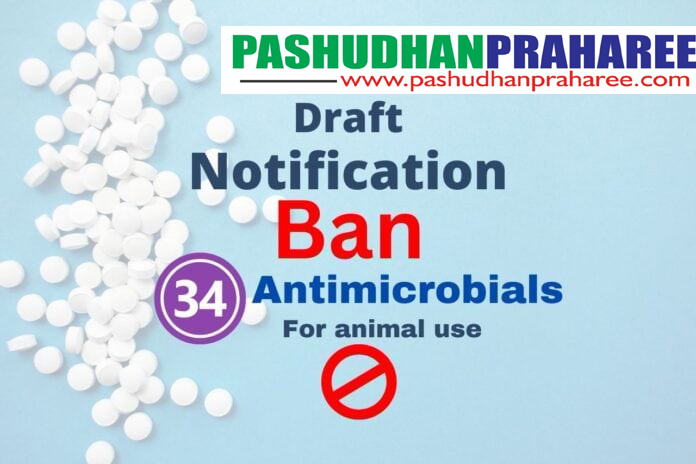
India to Ban 34 Antimicrobials for animal use to boost growth of livestock meant for exports
In a landmark decision aimed to address the growing concern around antimicrobial resistance (AMR) and transference of antibiotic resistance genes (ARG) from animal to human microbiota, the Food Safety and Standards Authority of India (FSSAI) banned the use of specific antibiotics in the production of meat, meat products, milk, milk products, poultry, eggs, and aquaculture from April 1.
This follows India’s commitment to the Muscat Ministerial Manifesto on AMR in November 2022 where two key decisions were taken: Reducing the total amount of antimicrobials used in agrifood systems by at least 30 per cent to 50 per cent by 2030 and preserving critically important antimicrobials for human medicine and ending the use of medically important antimicrobials for growth promotion in animals.
The government has banned use of certain antimicrobial medicinal products to promote growth or increase yield in rearing of poultry birds, livestock, including cattle, buffalo, sheep, goat, and beekeeping farms meant for export purposes.
In separate orders dated July 15, the Department of Commerce said it has amended the quality control order pertaining to milk and milk products, honey, animal casing, and egg and egg products.
“…Use of any antimicrobial medicinal product for the purpose of promoting growth or to increase yield shall be prohibited in rearing of poultry birds,” one of the orders said.
It said the use of specified antimicrobials or a group of antimicrobials and antimicrobial medicinal products shall be prohibited for treatment in poultry farms from where birds are procured, or at any stage of production and processing of poultry meat and poultry meat products in establishments.
These drugs include 18 antibiotics, 18 antivirals and an antiprotozoal.
The government has prohibited the use of 18 antibiotics, 18 antivirals and one anti-protozoan for treatment in egg laying birds, milch animals, bees and Cattle, Buffalo, Sheep, Goat and Pigs farm from where intestines are procured, or at any stage of production and processing of Animal Casing in establishment.“The use of any antimicrobial medicinal product for the purpose of promoting growth or to increase yield shall be prohibited,” the commerce and industry ministry said in separate notifications.It said that the use of any of the following antimicrobials or group of antimicrobials and antimicrobial medicinal product shall be prohibited for treatment of honey bees, milch animals, egg laying birds and cattle, goat, buffalo, sheep and pigs from where intestines are procured, or at any stage of production and processing of Animal Casing in establishment, or from where they are procured, or at any stage of production and processing.
Antimicrobials
Download the notification: The Union Health Ministry issued a draft notification vide No. S.O. 2298(E) dt 22-05-2025 to prohibit the import, manufacture, and sale of 34 critical antimicrobials and their formulations for veterinary use.
This follows the recommendations of the Drugs Technical Advisory Board (DTAB). This harmonizes India with world-guided standards.
Such a move has been recognized as a huge ban from the EU and countries intent on preserving critical medications for humans.
Transmission from animal to human
This is an important, if not obvious, step to take for the purpose of making sure that critical antimicrobials are reserved for humans.
The more we use these medications in livestock—for everything from growth promotion to prophylaxis against infection—the sooner we develop superbugs that are resistant to medications and can transform into human ailments.
Using this class of medications for animals when there are other formulations available only promotes the potential for drug-resistant bugs that can be easily transmitted from animal to human.
Keeping these critical formulations for humans allows for their use and efficacy for many generations down the line.
What Are the Antimicrobials?
The antimicrobials are listed in the proposed draft notification with the intention to prohibit them in the notification dated May 22.
There are 34 antimicrobials as follows:
Antibiotics (15 classes/drugs):
- Ureidopenicillins
- Ceftobiprole
- Ceftaroline
- Siderophore cephalosporins
- Carbapenems
- Penems
- Monobactams
- Glycopeptides
- Lipopeptides
- Oxazolidinones
- Fidaxomicin
- Plazomicin
- Glycylcyclines
- Eravacycline
- Omadacycline
Antivirals (18 drugs):
- Amantadine
- Baloxavir marboxil
- Celgosivir
- Favipiravir
- Galidesivir
- Lactimidomycin
- Laninamivir
- Methisazone/Metisazone
- Molnupiravir
- Oseltamivir
- Peramivir
- Ribavirin
- Rimantadine
- Tizoxanide
- Triazavirin
- Umifenovir
- Zanamivir
- Nitazoxanide
Antiprotozoal (1 drug):
- Nitazoxanide
What Else Has Recently Been Banned?
This is not the first time that human betterment has increased India’s preemptive action for drug safety, and it won’t be the last.
At the close of 2024, the Union Health Ministry prohibited the manufacture and sale of the vasodilator nimesulide and its formulations for use in animals.
Q. Why are antimicrobials being banned for animal use?
The reason for this ban is specifically to prevent AMR—antimicrobial resistance—which causes pathogens to develop resistance against antibiotics, making treatments in humans difficult and hospitalization a challenge. By reserving important antimicrobials exclusively for human use, the government hopes to retain human efficacy for important antimicrobials for generations to come.
Q. What types of drugs are included in this proposed ban?
Drugs included in the proposed ban include 15 classes of antibiotics (carbapenems, glycopeptides), 18 antiviral drugs (oseltamivir, molnupiravir), and nitazoxanide as the antiprotozoal drug.
List of 34 Antimicrobials Ban for animal use to boost growth of livestock meant for exports

LIST OF 34 ANTIMICROBIALS (FOR ANIMAL USE) BAN BY GoI