

Influence of Nutrition on the Immune System in Livestock
Dr. S. Navaneetha Krishnan M.V.Sc., PGDAW.,
Animal Nutritionist, Dindigul Dist, Tamilnadu.
“Modulation of immune function in food producing animals designed to optimize gut health, general well-being and production performance- with special emphasis on yeast cell wall components”
Introduction
Over the past 20–30 years, livestock production has shifted from disease treatment to prevention, driven by three major factors: recognition of economic losses due to mortality and morbidity, growing evidence of the immune system’s role in productivityand consumer demand for alternatives to antibiotics. Central to these changes is the strong influence of nutrition on immunity, particularly the gut-associated immune system, which forms the primary defense barrier and has specific nutrient requirements. Understanding how nutrition modulates gut immunity is essential for improving productivity and sustainability. Natural feed additives, especially yeast-derived products, offer promising strategies to enhance immune function and animal well-being.
Basic aspects of immune system – with emphasis on the G.I.T.
In healthy livestock, the immune system provides layered defense against pathogens. Physical barriers such as skin and mucous membranes form the first line of protection. If breached, the innate immune system mounts a rapid, non-specific response, followed by activation of the adaptive immune system, which develops immunological memory for faster, stronger responses upon future exposure. The gastro-intestinal tract (GIT) is the major entry point for pathogens and is protected by a mucus layer and a specialized mucosal immune system. This system, comprising innate and adaptive components, prevents microbial invasion, limits antigen uptakeand regulates immune reactions. Over 70% of immunocytes are associated with mucosa-associated lymphoid tissues, particularly gut-associated lymphoid tissue (GALT), the largest lymphoid organ. GALT includes Peyer’s patches and mesenteric lymph nodes, where B cells produce secretory IgA for luminal defense.
GALT is highly selective, balancing protection and tolerance despite constant antigen exposure. Its development begins at birth and matures with nutrition and microbial colonization. However, stress, weaning, parturition, reduced intake, or subclinical disease can suppress GIT immunity. Therefore, targeted nutrition and feed additives are essential to support GALT function, enhance immunityand maintain productivity and animal well-being.
Gut immune stimulation through dietary components.
From birth, animals receive diets that vary widely in quantity and composition, requiring continuous adaptation by both the animal and its immune system. Nutrient requirements for optimal production and for immunity particularly gut immunity are not always identicaland their priority shifts with production level or pathogen exposure. Immune activation demands substantial nutrients, especially energy, thereby diverting resources from growth and performance. Even mild infections tax nutrient reserves and reduce productive efficiency.
Interactions between immunity and nutrition are well established and operate through three main mechanisms:
(1) Specific nutrient needs for immune development and maintenance;
(2) Altered nutrient intake, metabolismand partitioning during immune activation
(3) Pathological effects of infection on nutrient utilization.
These processes are closely linked to stress-induced hormonal changes, often leading to reduced feed intake. Although decreased intake may seem detrimental, it supports homeostasis by limiting endogenous losses, increasing IgA concentrationand restricting nutrients available to pathogens. Because cytokine-mediated appetite suppression is difficult to overcome, enhancing immune support generally requires improving dietary nutrient density rather than simply increasing feed intake.
Incorporating the immune system in feeding strategies
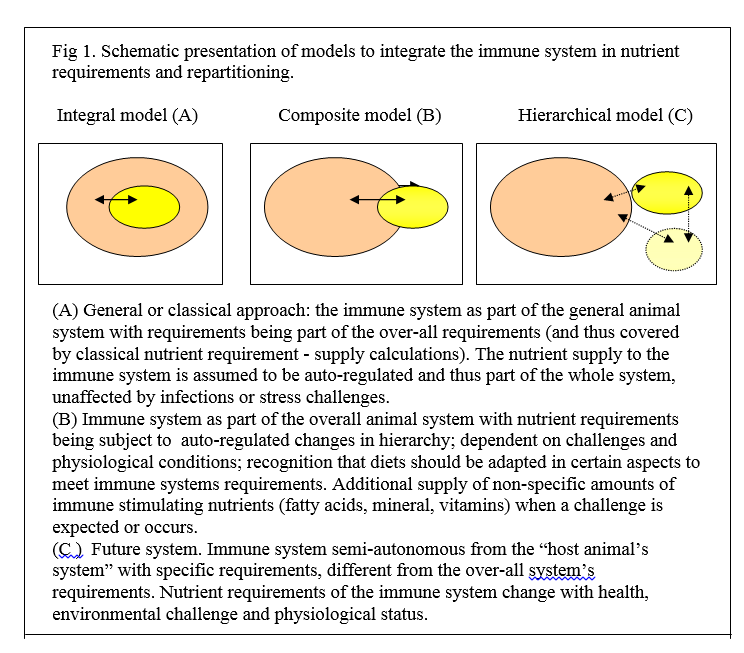
Traditionally, immune nutrient needs were assumed to be met within overall animal requirements. However, research shows the immune system has semi-autonomous and specific nutrient demands that differ from those of the host animal. Despite this, feeding models rarely account for immune-specific requirements, even though immunity especially at the gut level strongly influences nutrient utilization and productivity. Current approaches often add extra fatty acids, vitamins, or minerals under specific conditions, but these are largely arbitrary adjustments. Because immune demands vary with production stress and health challenges, nutrient supply should be dynamically adjusted. Integrating immune-specific needs into feeding strategies is essential for optimal performance and animal well-being.
Specific Nutrient effects
Historically, from a nutrient supply perspective, the immune system has been considered an integral part of the whole animal, with established nutrient requirements assumed to meet its needs. However, growing evidence indicates that the immune system has semi-autonomous and specific nutrient demands that may differ from those of the host animal. Despite this recognition, feeding systems rarely integrate immune-specific requirements into ration formulation. The interaction among maintenance, productionand immune demands is highly dynamic and cannot be fully addressed through conventional nutrient supply models. A better understanding of immune–nutrient interactions is therefore essential for optimizing productivity and animal well-being.
Energy
Energy is the primary nutrient required for immune cell proliferation, activationand synthesis of defense molecules. During immune stimulation, energy is diverted from growth and production toward supporting immune responses. This shift alters nutrient partitioning and increases maintenance requirements. Insufficient energy supply can impair immune competence, while excessive immune activation can reduce productive efficiency.
Fatty Acids
Fatty acids play a regulatory role in immune function by influencing cell membrane structure and inflammatory responses. Certain fatty acids act as precursors for signaling molecules that modulate inflammation. Adjusting fatty acid composition in the diet can therefore influence immune responsiveness, particularly under stress or disease challenge.
Vitamins and Minerals
Vitamins and minerals are essential for maintaining immune integrity. They function as cofactors in enzymatic reactions, support antioxidant defense systemsand regulate cellular immunity. In practice, supplementation is often provided above standard requirements during stress or disease conditions, though these adjustments are not always based on dynamic assessment of immune needs.
Amino Acids
Amino acids are critical for the synthesis of immune proteins, antibodies, cytokinesand acute-phase proteins. Specific amino acids may become limiting during immune activation due to increased demand for tissue repair and immune cell proliferation. Ensuring adequate amino acid supply is therefore vital for balancing immune competence and productive performance. To maximize animal performance and health, feeding systems must move beyond static requirement models and incorporate the variable, condition-dependent nutrient needs of the immune system.
Additives effects – yeast and yeast cell walls
Numerous feed additives are used in livestock diets, many influencing immunity either directly or indirectly. Among these, yeast cell wall (YCW) components from Saccharomyces cerevisiae are prominent due to their diverse composition and broad effects. The primary structural components of YCW are β-glucans (mainly β-1,3 with β-1,6 branches) and mannan-proteins, from which manno-oligosaccharides (MOS) are derived. Composition varies with strain and growth conditions, leading to differences in efficacy. For optimal activity, β-glucans and MOS are typically separated, as intact yeast shows limited immune effects.
YCW components exert two principal functions: immune modulation and pathogen adsorption. The β-glucan fraction enhances immunity by activating leukocytes, stimulating phagocytosis, antimicrobial activityand cytokine production. This supports pathogen clearance, improved gut integrityand favorable microbial balance. In contrast, MOS binds pathogenic bacteria through lectin interactions, preventing their attachment to intestinal epithelial cells. MOS may also stimulate mucin secretion, facilitating the removal of pathogen mucin complexes before colonization occurs. Together, these mechanisms indirectly enhance gut health and nutrient utilization. Although beneficial effects such as improved microbial balance, gut integrityand performance have been widely reported especially in poultry and pigs responses can be variable. β-glucans are most effective under immune challengeand measurable immune changes do not always translate into performance gains. MOS responses are more consistently associated with improved gut health, though immune effects may be indirect.
For YCW to function effectively, components must resist digestion in the upper gastrointestinal tract while maintaining structural integrity. Digestibility varies among species and age groups, with greater fermentation occurring in the lower gut. In ruminants, rumen fermentation may limit direct effectsand knowledge of YCW interactions with rumen microbes remains limited. Overall, β-glucans and MOS represent promising alternatives to antibiotic growth promoters, particularly in monogastric animals. However, variability in product composition and response highlights the need for improved standardization and precise application strategies to optimize production outcomes.
Conclusion
Production pressures along with consumer demands for improved animal well-being and removal of AGP have placed immunity and our capacity to modulate the animal’s immune system in the forefront of animal production concerns. The immune system and its response to nutritional interventions remain poorly understood; this is especially the case for the gut associated immune system. The nutritional cost of an immune response is rarely taken into consideration despite the realization that such a response may represent a significant (dietary) cost. At present, no or limited specific provisions are made in our diet calculations to improve the immune response and reduce losses associated with this response. Incorporation of the specific nutrient requirements of the immune system in the overall nutrition of the domestic animal may improve the animal’s health and well being, productive capacity and global cost of production.
Positive responses in immune stimulation and immune status have been obtained by supplying specific nutrients. This is especially the case for the classical nutrients such as amino acids and vitamins or micro-minerals. However, specific fatty acids may provide an easier means to directly or indirectly affect the immune response at the GIT level. In this – as well as other interventions ,the role of commensurate microbial population will need to be taken into consideration. Many of the existing, recognized, nutritional interventions aimed at modulating the immune response interact directly with this microbial population and may be affected through this interaction. The example of specific components of one group of additives – the yeast cell wall components could be taken as a case in point. Yeast cell wall components can effectively stimulate the GIT immune system through a direct effect (β-glucans) and indirectly through modifying the microbial population. In both cases beneficial responses in production and animal well- being have been obtained.