
LANTANA CAMARA TOXICITY IN CATTLE
Recognising the Hidden Risk During Fodder Scarcity and Protecting Cattle in the Field
Dr. Supreetkumar Sagar, M.V.Sc., NET, PGDAW1 and Dr. Sanjeev S. Pitlawar, M.V.Sc., PhD, PGDAW2
1: Veterinary Surgeon (Gold medalist), ALUMNUS,College of Veterinary and Animal Sciences, Udgir, Maharashtra Animal & Fishery Sciences University, Nagpur
2: Associate Professor and Sectional Head, Department of Veterinary Surgery and Radiology, College of Veterinary and Animal Sciences, Udgir, Maharashtra Animal & Fishery Sciences University, Nagpur
The weed hiding in plain sight
When grazing land turns dry and green fodder becomes scarce, cattle may begin eating plants that they normally avoid. One such plant is Lantana camara. What appears to be an ordinary roadside or wasteland shrub can become a serious threat when cattle consume it in sufficient quantities. The danger may not be obvious immediately; affected animals may later become dull, develop yellowish mucous membranes and show painful skin damage after exposure to sunlight.
Lantana poisoning is largely preventable. Recognising the plant, maintaining adequate fodder supply and acting quickly when suspicious signs appear can save an animal and reduce production losses.
Why does Lantana become a problem?
Lantana camara is a hardy invasive shrub found along roadsides, field boundaries, wastelands, forest margins and grazing areas. It survives under difficult conditions and can spread rapidly. During drought, summer, overgrazing or shortage of preferred fodder, cattle are more likely to browse unfamiliar plants.
The risk is therefore not only the presence of Lantana. The real danger increases when cattle have limited access to safe, nutritious fodder.
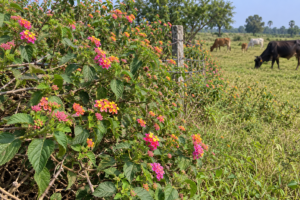
Lantana camara growing along a grazing area or field boundary
When should farmers be especially alert?
- Dry periods when pasture becomes poor and green fodder is limited.
- Animals grazing on wasteland, scrubland, roadsides or forest margins where Lantana is abundant.
- Overgrazed areas where preferred grasses and fodder plants have already disappeared.
- Fodder contaminated with Lantana leaves or plant material.
- Groups of cattle showing similar signs after grazing in the same area.
What makes Lantana poisonous?
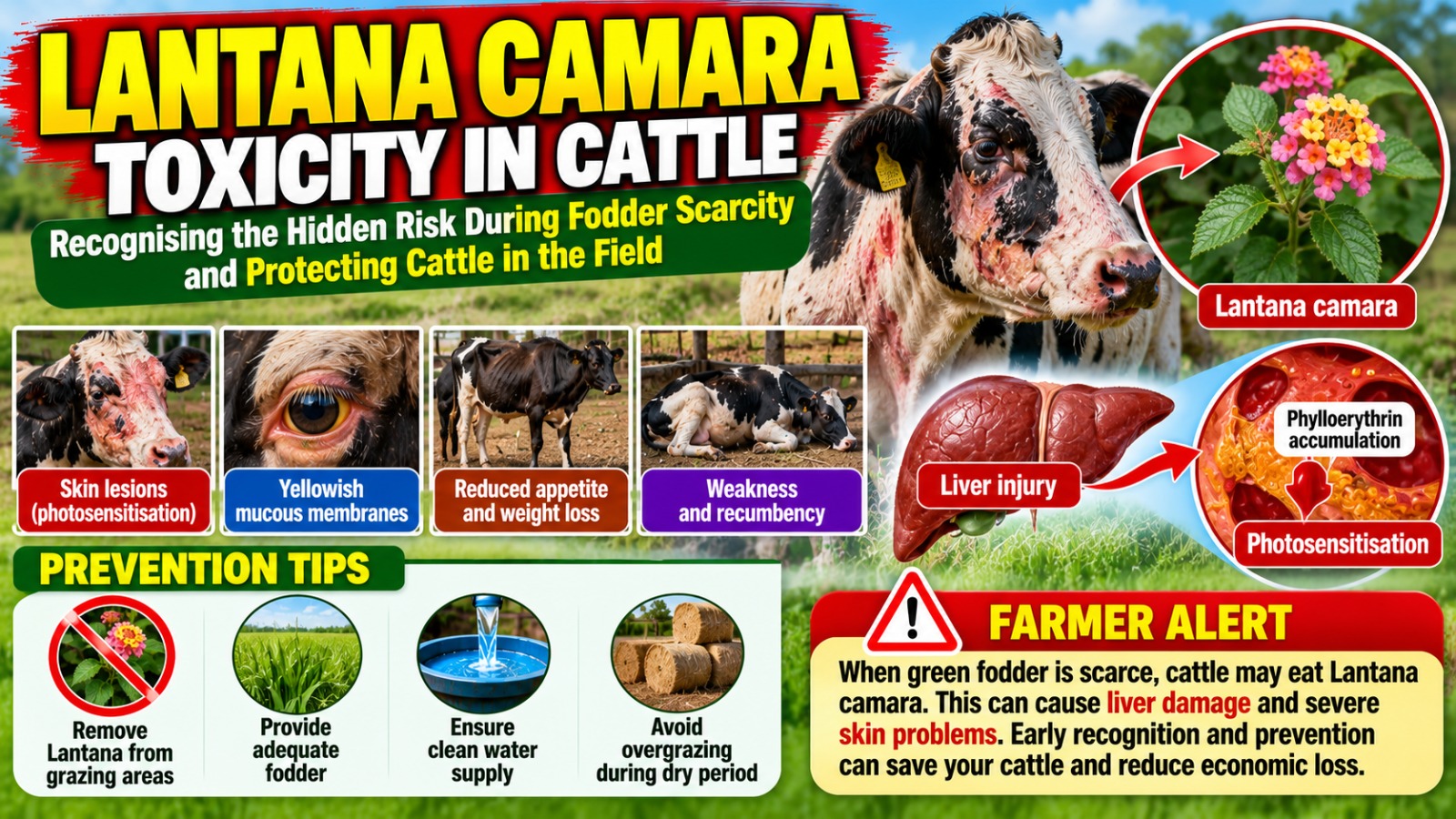
The principal toxic compounds are lantadenes, pentacyclic triterpenoids that can damage the liver. The resulting liver dysfunction interferes with normal bile flow and the handling of phylloerythrin, a pigment produced during chlorophyll breakdown.
When phylloerythrin accumulates in the blood and tissues, exposure to sunlight can trigger severe photosensitisation. Thus, the skin lesions seen in affected cattle are closely linked to liver injury rather than being simply a skin disease.
How does poisoning develop?
| Stage | What happens |
| 1. Consumption | Cattle ingest Lantana leaves or plant material, particularly when preferred fodder is scarce. |
| 2. Liver injury | Toxic lantadenes damage hepatocytes and disturb normal hepatic function and bile excretion. |
| 3. Pigment accumulation | Phylloerythrin may accumulate because the damaged liver cannot adequately process and excrete it. |
| 4. Sunlight reaction | Photosensitisation develops, producing painful skin damage in exposed areas. |
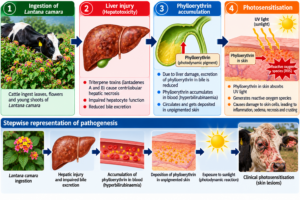

Lantana ingestion → liver injury → phylloerythrin accumulation → photosensitisation
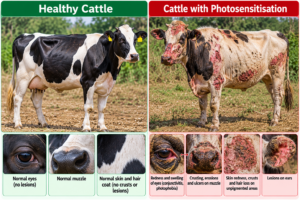
Comparison of healthy cattle and cattle showing photosensitisation
Signs farmers can identify
- Reduced appetite and reduced rumination.
- Dullness, weakness and reduced activity.
- Fall in milk production in lactating cattle.
- Yellowish discoloration of the eyes and other mucous membranes in significant liver injury.
- Redness, swelling, crusting, peeling or painful lesions on sun-exposed skin.
- Skin lesions commonly affecting the muzzle, face, ears, eyelids, udder or other exposed areas.
- Animals may seek shade or become restless because affected skin is painful.
- Severe cases may show marked weakness and poor recovery.
A useful field clue
Recent grazing + Lantana exposure + jaundice + painful skin damage after sunlight = suspect Lantana toxicity.
What should the farmer do immediately?
- Remove affected cattle from the suspected grazing area immediately.
- Provide clean water and good-quality, uncontaminated feed or fodder.
- Keep affected animals in shade and minimise direct sunlight exposure.
- Do not force an animal to walk unnecessarily if the skin is severely painful.
- Contact a veterinarian promptly, particularly when jaundice, marked weakness or extensive skin lesions are present.
- Keep other animals away from the suspected Lantana-infested area until the source of exposure is assessed.
Veterinary diagnosis and treatment
There is no simple farm-level antidote that reliably reverses established Lantana-induced liver injury. Diagnosis is based on history, clinical findings, exposure to the plant and exclusion of other causes of liver disease and photosensitisation. A veterinarian may recommend appropriate blood or biochemical testing when available.
Treatment is mainly supportive and should be individualised according to the severity of liver injury and dehydration or other complications. Gastrointestinal decontamination may be considered by a veterinarian when exposure is recent and the animal is clinically suitable; oral administration should never be forced into a weak animal with impaired swallowing.
Management of photosensitisation is particularly important. Affected cattle should be protected from direct sunlight, and damaged skin should be managed hygienically under veterinary guidance. Severe cases may require intensive supportive care.
Do not mistake it for a simple skin disease
| Observation | Possible concern | What to do |
| Skin lesions after grazing | Photosensitisation | Check for Lantana and other hepatotoxic plants; call veterinarian. |
| Yellow mucous membranes | Liver dysfunction or other causes of jaundice | Veterinary examination required. |
| Several cattle affected together | Common feed/grazing exposure | Remove access to suspected area/feed. |
| Severe weakness or poor swallowing | Serious systemic illness | Do not force oral drenching; seek veterinary care. |
Prevention starts with fodder security
The most effective control is to prevent cattle from eating Lantana. Farmers should not depend on cattle avoiding the plant on their own, especially during fodder shortages.
- Identify Lantana-infested grazing areas before allowing cattle to graze.
- Control or remove Lantana from important grazing and fodder collection areas using locally appropriate methods.
- Maintain a reserve of dry fodder and safe green fodder for periods of pasture shortage.
- Avoid severe overgrazing so that preferred grasses remain available.
- Inspect harvested fodder for leaves or plant material from unfamiliar weeds.
- Do not deliberately feed Lantana as a substitute for fodder.
- Where community grazing land is involved, coordinate weed control at village level rather than treating isolated plants only.
Village-level weed-control and fodder-security activity
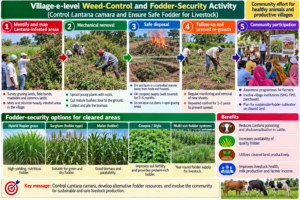
A practical village-level Lantana control programme
IDENTIFY – Farmers and livestock workers learn to recognise Lantana.
MAP – Mark heavily infested grazing, roadside and wasteland areas.
CONTROL – Remove/control the weed using locally suitable and safe methods.
FEED – Strengthen fodder reserves before the dry season.
MONITOR – Watch cattle after grazing in risk areas.
REPORT – Inform the local veterinary professional if several animals develop compatible signs.
Lantana plant recognition and immediate farmer actions.
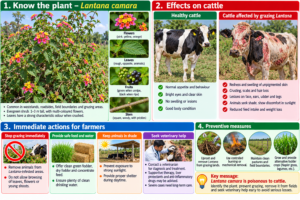
Farmer’s quick checklist
- Is Lantana growing in the grazing area?
- Has fodder become scarce recently?
- Are cattle browsing unusual shrubs or weeds?
- Has milk yield suddenly fallen?
- Are animals dull or eating less?
- Are the eyes or gums becoming yellowish?
- Are sun-exposed areas of the skin red, painful or peeling?
- Have several cattle developed similar signs?
- Have affected cattle been moved into shade?
- Has a veterinarian been contacted?
Five rules to remember
- Do not allow cattle to depend on scrub and wasteland grazing when safe fodder is available.
- Learn to recognise Lantana before the dry season begins.
- Suspect liver-related photosensitisation when jaundice and sun-sensitive skin lesions occur together.
- Move suspected cases away from Lantana and into shade immediately.
- Do not delay veterinary examination in severe or rapidly worsening cases.
Economic importance
Lantana poisoning can reduce milk production, increase treatment costs and cause prolonged recovery when liver injury and photosensitisation are severe. Preventing exposure is therefore not only an animal-health measure but also an important farm-income protection strategy.
Conclusion
Lantana camara toxicity is a preventable problem that becomes more important when grazing conditions deteriorate and cattle face fodder scarcity. The combination of appropriate fodder management, recognition of Lantana, early removal from exposure and rapid veterinary attention can substantially reduce losses. Farmers, livestock workers and veterinary professionals should work together to identify infested areas and protect animals before the dry season turns a common weed into a serious livestock hazard.
References
- Pass, M. A. (1986). Current ideas on the pathophysiology and treatment of lantana poisoning of ruminants. Australian Veterinary Journal, 63(6), 169–171. https://doi.org/10.1111/j.1751-0813.1986.tb02965.x
- Riet-Correa, F., et al. (2023). Lantana camara poisoning in cattle that took refuge during a storm in a forest invaded by this plant. Toxicon, 229, 107124. https://doi.org/10.1016/j.toxicon.2023.107124
- Sharma, O. P., Makkar, H. P. S., Dawra, R. K., & Negi, S. S. (1981). A review of the toxicity of Lantana camara (Linn.) in animals. Clinical Toxicology, 18(9), 1077–1094. https://doi.org/10.3109/15563658108990337
- Sharma, O. P., Makkar, H. P. S., & Dawra, R. K. (1988). A review of the noxious plant Lantana camara. Toxicon, 26(11), 975–987. https://doi.org/10.1016/0041-0101(88)90196-1
- Sharma, O. P., Sharma, S., Pattabhi, V., Mahato, S. B., & Sharma, P. D. (2007). A review of the hepatotoxic plant Lantana camara. Critical Reviews in Toxicology, 37(4), 313–352. https://doi.org/10.1080/10408440601177863
- Shridhar, N. B., Srinivasan, G., Sunilchandra, U., Tikare, V. P., & Waghe, P. K. (2022). Lantana camara: A toxic weed in livestock development. Indian Journal of Veterinary and Animal Sciences Research, 51(6), 1–10. https://doi.org/10.56093/ijvasr.v51i6.135319
- Srikanth, K., & Satish Kumar, K. (2013). Dermatitis due to Lantana toxicity and its management: A report of eight cattle. Intas Polivet, 14(2), 218–220.