



Practical Strategies for the Prevention and Treatment of Ketosis in Dairy Herds
B.V. Sunil Kumar*, Smrutirekha Mallick, Rahul Singh Arya and Shyam Singh Dahiya
ICAR-National Institute on Foot and Mouth Disease, Bhubaneswar-752050
*Corresponding author: drbvskumar@gmail.com
Abstract
Ketosis is one of the most prevalent metabolic disorders affecting high-producing dairy cattle during the transition and early lactation periods, characterized by negative energy balance and elevated concentrations of ketone bodies such as β-hydroxybutyrate (BHBA) and acetoacetate in blood, milk, or urine. The condition results primarily from excessive mobilization of adipose reserves to meet the high energy demands of lactation, leading to hepatic fat accumulation and impaired gluconeogenesis. Effective management of bovine ketosis requires an integrated approach encompassing early diagnosis, nutritional intervention, and metabolic monitoring. Diagnostic strategies include cow-side tests for BHBA and acetoacetate, along with precision technologies for continuous energy balance assessment. Preventive measures focus on optimizing prepartum and postpartum nutrition through adequate dietary energy density, controlled body condition scoring, and balanced supplementation of glucogenic precursors such as propylene glycol and niacin. Therapeutic management involves intravenous glucose administration, corticosteroids, and oral propylene glycol drenching to restore normoglycemia. Emerging strategies, including rumen-protected choline, monensin supplementation, and precision feeding models, offer promising avenues for minimizing subclinical cases. A comprehensive herd-level ketosis control program integrating nutritional management, metabolic profiling, and data-driven decision-making can significantly enhance milk yield, reproductive performance, and overall herd health.
Keywords: bovine ketosis, β-hydroxybutyrate, negative energy balance, metabolic disorder, dairy cow management, propylene glycol, transition period
Introduction
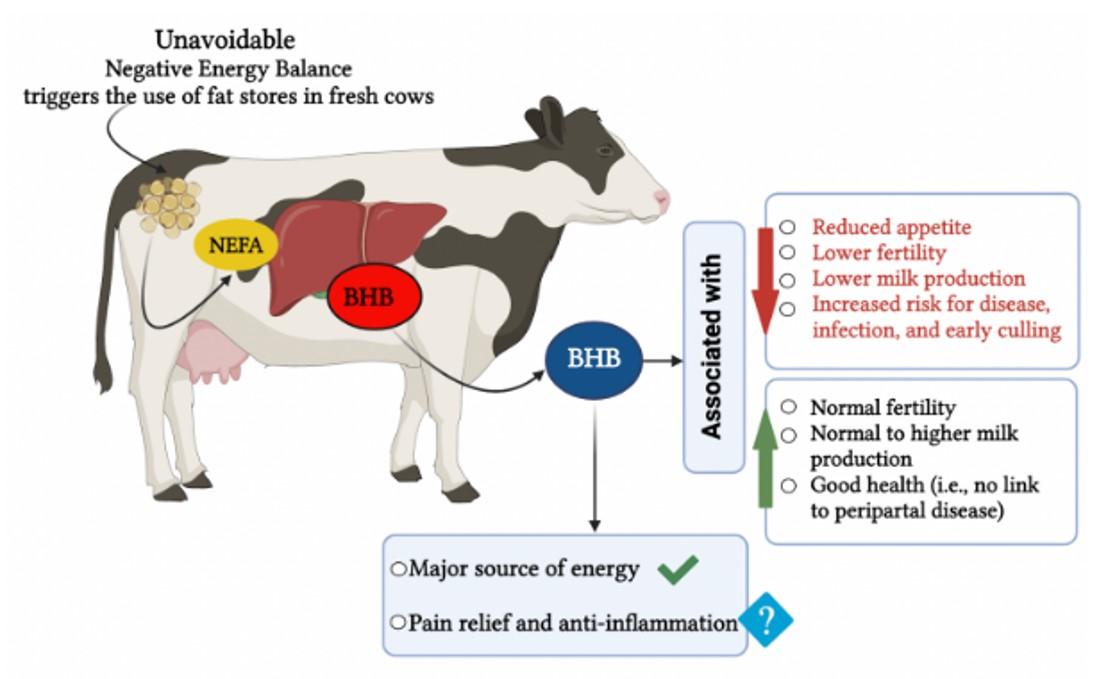
Ketosis is a metabolic disorder that arises from disruptions in carbohydrate and volatile fatty acid metabolism, typically occurring during periods of high energy demand in ruminants. When energy requirements exceed dietary intake, mobilization of adipose tissue releases non-esterified fatty acids (NEFAs) into circulation. These NEFAs are converted into fatty acyl-CoA in the liver, where excessive oxidation under negative energy balance leads to the overproduction of ketone bodies—namely acetoacetate, β-hydroxybutyrate (BHBA), and acetone. Acetoacetate may spontaneously decarboxylate to form acetone. Collectively, these three compounds are referred to as ketone or acetone bodies.
In healthy animals, circulating ketone body concentrations generally remain below 1 mg/100 mL; slightly higher levels are normal in ruminants. When the levels of ketone bodies rise beyond physiological limits, the condition manifests as ketonemia (elevated ketone bodies in blood) or ketonuria (elevated ketones in urine). The state of excessive accumulation of ketone bodies in blood and tissues is termed ketosis.
Ketosis occurring in early lactation, often associated with hepatic lipid infiltration, is referred to as type II ketosis. Cases that emerge around peak milk yield (4–6 weeks postpartum) are generally linked to inadequate dietary intake of glucogenic substrates and are classified as type I ketosis.
During pregnancy and lactation, ruminants experience heightened glucose and amino acid demand. When lipid catabolism becomes excessive, due to insufficient gluconeogenesis, hyperketonemia, hypoglycemia, and hepatic glycogen depletion develop. In cattle, ketosis predominantly appears during peak lactation, whereas in ewes it occurs during late gestation, particularly in twin-bearing animals, where it is recognized as pregnancy toxemia.
Based on clinical severity, ketosis is classified into two forms:
- Clinical ketosis– Characterized by blood BHBA concentrations ≥3.0 mmol/L (31.2 mg/dL), typically affecting up to 15% of cows.
- Sub-clinical ketosis– Defined by BHBA levels ≥1.2 mmol/L (12.4 mg/dL), observed in more than 40% of cows in modern dairy herds.
Diagnosis
- Pre-calving indicators
Elevated NEFA concentrations (>0.30 mEq/L) or BHBA levels (0.6–0.8 mmol/L; ≥6.25 mg/dL) before parturition are strong predictors of subsequent clinical ketosis, as well as related metabolic complications such as metritis, retained placenta, and displaced abomasum.
- Post-calving indicators
Postpartum NEFA concentrations are considered superior predictors of metabolic stress compared to BHBA. Within the first 14 days in milk, NEFA levels exceeding 0.6–0.7 mEq/L indicate high risk. Thresholds for BHBA are ≥1.2 mmol/L (12.4 mg/dL) for sub-clinical and ≥3.0 mmol/L (31.2 mg/dL) for clinical ketosis.
- Diagnostic testing
For reliable detection, individual testing should be performed twice between 3–14 days postpartum. At the herd level, if more than 1 in 12 cows test above the 1.2 mmol/L BHBA threshold, ketosis is considered prevalent.
- Rothera’s test:Utilizes sodium nitroprusside tablets to detect urinary ketones.
- Dipstick assays:Used for rapid estimation of ketones in urine or plasma.
- Blood glucose and ketone analysis:Glucose levels <40 mg/dL, total blood ketones >30 mg/dL, and milk ketones >10 mg/dL are indicative of ketosis. In small ruminants, glucose <25 mg/dL combined with ketonuria confirms diagnosis.
- Visual assessment
A distinct ketone odor on the animal’s breath or milk is a common sign. Rapid post-calving loss of body condition (0.5–0.75 BCS or 40–65 kg body weight) also suggests ketosis. Advanced 3D imaging technologies can assist in body condition scoring. Reduced dry matter intake (DMI) can be inferred from decreased rumen fill and a straight belly line, indicating prolonged feed deprivation.
Treatment of Ketosis
Therapeutic management aims to restore blood glucose concentrations and reduce circulating ketone levels.
- Intravenous glucose:Administration of 500 mL of 50% dextrose solution is the most common and effective immediate treatment (IV only due to hyperosmolarity).
- Glucocorticoid therapy:Dexamethasone or isoflupredone acetate (5–20 mg IM) supports sustained recovery when combined with glucose therapy.
- Oral propylene glycol:Administered at 250–400 g once daily, serves as a potent gluconeogenic precursor.
- Insulin therapy:Long-acting insulin (150–200 IU/day IM) may be beneficial, particularly for type II ketosis cases.
- Supportive care:Restoration of electrolyte balance via IV isotonic saline, sodium bicarbonate, or sodium lactate solutions, with potassium supplementation, is essential in prolonged cases.
Prevention of Ketosis
- Optimizing Dry Matter Intake (DMI):
Ensuring high DMI during the transition period is the most effective preventive measure. Adequate fiber intake must be maintained to support rumen health, as excessive dietary energy density may predispose cows to ruminal acidosis and secondary ketosis.
- Prophylactic Propylene Glycol:
Strategic oral administration of propylene glycol during early lactation can help maintain insulin levels, minimize lipid mobilization, and prevent hepatic fat accumulation.
- Feed Additives:
Inclusion of yeast cultures and phytogenic additives enhances rumen buffering capacity, stabilizes pH, and promotes feed intake. Supplementation with choline and methionine assists in lipid export from the liver, reducing hepatic steatosis.
- Feed Bunk Management:
Adequate feed bunk space for dry cows minimizes social stress and promotes consistent feeding behavior—critical for maintaining energy balance pre- and post-partum.
- Special Cases:
- Diabetic ketosis:Treatment includes carbohydrate-rich diets, intramuscular insulin, and administration of anti-ketogenic agents such as aspartic acid, which provides oxaloacetate for the tricarboxylic acid cycle.
- Starvation ketosis:Managed through carbohydrate supplementation and aspartic acid administration to restore metabolic intermediates.
References
Benedet, A., Satoła, A., et al. “Predicting Subclinical Ketosis in Dairy Cows Using Test‐Day Data and Machine Learning Methods.” Animals, 2021; 11(7):2131. DOI:10.3390/ani11072131.
García‐Ispierto, I., Camacho, J., et al. “Prevalence of subclinical ketosis and production diseases in dairy cows worldwide: A cross‐sectional study.” Translational Animal Science, 2019; 3(1):84-92.
Melendez, P., McArt, J. A. A. “Update on ketosis in dairy cattle with major emphasis on subclinical ketosis.” Veterinary Medicine and Science, 2024. DOI: 10.1002/vms3.1525.
Steeneveld, W., Amuta, P., van Soest, F. J. S., Jorritsma, R., Hogeveen, H. “Estimating the combined costs of clinical and subclinical ketosis in dairy cows.” PLoS ONE, 2020; 15(4): e0230448. DOI:10.1371/journal.pone.0230448.
Zhao, C., Wang, H., Liu, G., et al. “Metabolic alterations in dairy cows with subclinical ketosis: A pilot study using CMC-rGSH nanoparticles.” Journal of Animal Physiology and Animal Nutrition, 2020