



Bacterial Etiology and Pathogenesis of Subclinical Mastitis in Dairy Animals
Bhawana, Dr. Shweta Anand
Dr. Mahesh Kumar Bharti, Dr. Rajiv Ranjan Kumar, Dr. Ashok Kumar Mohanty
Deptt. of Veterinary Pharmacology & Toxicology
COVAS, SVPUA&T Meerut
ICAR CIRC MEERUT
Introduction
Subclinical mastitis is one of the most widespread and economically significant diseases affecting dairy animals worldwide. Unlike clinical mastitis, which presents visible signs such as swelling of the udder, pain, redness, and abnormal milk, subclinical mastitis remains hidden and often goes unnoticed by farmers. The disease is characterized by inflammation of the mammary gland without obvious clinical symptoms, making it a silent threat to dairy production.
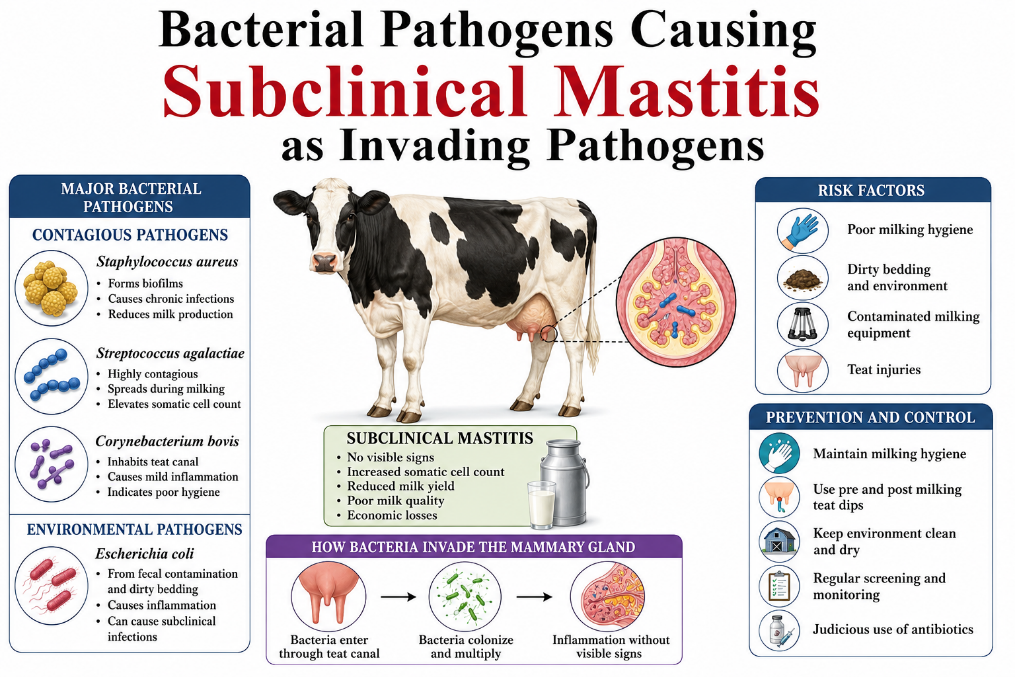
The primary cause of subclinical mastitis is the invasion of pathogenic microorganisms, particularly bacteria, into the mammary gland. These invading pathogens penetrate through the teat canal, multiply within the udder tissue, and trigger inflammatory responses that adversely affect milk quality and yield. Understanding the major bacterial pathogens responsible for subclinical mastitis is essential for effective diagnosis, prevention, and control.
How Bacteria Invade the Mammary Gland
The teat canal acts as the first line of defense against microbial invasion. However, when this natural barrier is compromised due to poor hygiene, teat injuries, improper milking practices, or environmental contamination, bacteria can enter the udder. Once inside, they colonize the mammary tissue and evade the host’s immune defenses, resulting in persistent infections.
The pathogens causing subclinical mastitis are generally classified into two major groups:
- Contagious pathogens
- Environmental pathogens
Both groups contribute significantly to the occurrence of subclinical mastitis in dairy herds.
Major Contagious Bacterial Pathogens
- 1. Staphylococcus aureus
Staphylococcus aureus is considered one of the most important and persistent pathogens causing subclinical mastitis. It spreads primarily during milking through contaminated hands, milking equipment, and infected udders.
Characteristics:
- Forms biofilms that protect bacteria from antibiotics and immune cells.
- Causes chronic and recurrent infections.
- Reduces milk production significantly.
- Difficult to eliminate once established.
Economic Impact:
Infections caused by Staphylococcus aureus lead to reduced milk yield, increased somatic cell count (SCC), treatment costs, and premature culling of animals.
- Streptococcus agalactiae
Streptococcus agalactiae is a highly contagious udder pathogen that survives mainly within the mammary gland.
Characteristics:
- Spreads rapidly between animals during milking.
- Causes elevated somatic cell counts.
- Responds relatively well to antibiotic therapy when detected early.
Importance:
Routine screening and proper milking hygiene can effectively reduce infections caused by this pathogen.
- Corynebacterium bovis
Corynebacterium bovis is frequently isolated from subclinical mastitis cases and inhabits the teat canal.
Characteristics:
- Usually causes mild inflammation.
- Often associated with increased somatic cell counts.
- Indicates poor teat sanitation practices.
Although considered less pathogenic than Staphylococcus aureus, its presence reflects inadequate udder hygiene.
Major Environmental Bacterial Pathogens
Environmental pathogens originate from bedding, manure, soil, water, and contaminated surroundings.
- Escherichia coli (E. coli)
Escherichia coli is one of the most common environmental pathogens affecting dairy animals.
Sources:
- Fecal contamination
- Dirty bedding materials
- Unsanitary housing conditions
Characteristics:
- Invades the udder rapidly.
- Produces endotoxins that stimulate inflammation.
- Can cause both clinical and subclinical infections.
Improved cleanliness and proper housing management are essential for controlling E. coli infections.
- Streptococcus uberis
Streptococcus uberis is widely distributed in the dairy environment and is increasingly recognized as a major cause of subclinical mastitis.
Characteristics:
- Survives in bedding, soil, and manure.
- Causes persistent intramammary infections.
- Leads to substantial milk production losses.
Risk Factors:
- Wet and dirty housing conditions.
- Poor udder preparation before milking.
- Streptococcus dysgalactiae
This bacterium occupies an intermediate position between contagious and environmental pathogens.
Characteristics:
- Found on skin surfaces and in the environment.
- Causes chronic subclinical infections.
- Results in elevated somatic cell counts.
Proper teat disinfection before and after milking helps reduce its transmission.
- Klebsiella Species
Species such as Klebsiella pneumoniae are commonly associated with contaminated bedding materials, especially sawdust and wood shavings.
Characteristics:
- Highly opportunistic pathogens.
- Cause severe inflammatory responses.
- Difficult to control in poorly managed dairy farms.
Emerging Pathogens in Subclinical Mastitis
Recent studies have reported several emerging bacterial species associated with subclinical mastitis.
Coagulase-Negative Staphylococci (CNS)
These include:
- Staphylococcus chromogenes
- Staphylococcus epidermidis
- Staphylococcus simulans
Importance:
- Increasingly detected in dairy herds.
- Cause mild but persistent infections.
- Contribute significantly to elevated somatic cell counts.
Enterococcus Species
Enterococcus faecalis and Enterococcus faecium have emerged as opportunistic mastitis pathogens.
Characteristics:
- Survive under diverse environmental conditions.
- Exhibit antimicrobial resistance.
- Cause chronic intramammary infections.
Mechanisms Used by Invading Pathogens
Bacterial pathogens employ several strategies to establish infection:
Adhesion
Bacteria attach firmly to mammary epithelial cells, preventing their removal during milking.
Biofilm Formation
Many pathogens, especially Staphylococcus aureus, produce biofilms that protect them from antibiotics and immune responses.
Toxin Production
Certain bacteria release toxins that damage mammary tissues and trigger inflammation.
Immune Evasion
Pathogens develop mechanisms to escape destruction by immune cells, allowing long-term persistence in the udder.
Impact of Bacterial Invasion on Milk Quality
Subclinical mastitis affects milk quality in several ways:
- Increased somatic cell count.
- Reduced milk yield.
- Altered milk composition.
- Lower fat and protein content.
- Reduced shelf life of dairy products.
- Increased risk of antimicrobial residues following treatment.
These changes significantly affect the profitability of dairy farming and the quality of milk supplied to consumers.
Diagnosis of Bacterial Subclinical Mastitis
Early diagnosis is critical for controlling infections.
Common diagnostic methods include:
- California Mastitis Test (CMT)
- Somatic Cell Count (SCC)
- Electrical Conductivity Measurement
- Bacterial Culture and Isolation
- Polymerase Chain Reaction (PCR)
- Loop-Mediated Isothermal Amplification (LAMP)
- Biosensor-Based Detection Systems
- Artificial Intelligence-Assisted Diagnostic Tools
Among these methods, bacterial culture remains the gold standard for identifying specific pathogens.
Prevention and Control Strategies
Effective control of bacterial pathogens requires an integrated approach:
Milking Hygiene
- Wash and dry udders before milking.
- Use clean towels for each animal.
- Wear gloves during milking.
Teat Dipping
- Perform pre- and post-milking teat disinfection.
- Use approved disinfectant solutions.
Environmental Management
- Maintain clean and dry bedding.
- Remove manure regularly.
- Improve ventilation in animal housing.
Regular Screening
- Monitor somatic cell counts.
- Conduct routine California Mastitis Tests.
- Screen animals for subclinical infections.
Judicious Antibiotic Use
- Use antibiotics only after proper diagnosis.
- Follow veterinary recommendations.
- Monitor antimicrobial resistance patterns.
Conclusion
Subclinical mastitis remains a major challenge to the dairy industry due to its hidden nature and significant economic consequences. A wide range of bacterial pathogens, including Staphylococcus aureus, Streptococcus agalactiae, Escherichia coli, Streptococcus uberis, and emerging opportunistic bacteria, are capable of invading the mammary gland and establishing persistent infections. Understanding the biology, transmission, and pathogenic mechanisms of these invading microorganisms is essential for effective disease management. Through improved hygiene, regular monitoring, advanced diagnostic techniques, and appropriate control measures, dairy farmers can significantly reduce the burden of bacterial subclinical mastitis and enhance milk quality, animal welfare, and farm profitability.