

Climate change and its impact on dairy sector: Adaptation strategies
Introduction
Dairy is a important part of the human diet across the world. Dairy products are abundance source of nutrients like calcium, minerals, and proteins. Dairy sector helps to fulfilling the dietary and nutritional needs. The India accounting for 24% of global milk production. India rank first in milk production globally and contributing approximately 23-24% of the world’s total milk production. The per capita availability of milk in India 459 grams per day in 2022-23, which is notably higher than the global average of 322 grams per day. Major milk-producing states include Uttar Pradesh, Maharashtra, Himachal Pradesh, Madhya Pradesh, Rajasthan, Punjab, and Tamil Nadu, with these regions leading in both production and cooperative initiatives. The dairy sector plays a crucial role in India’s economy, employing over 80 million rural households, predominantly small and marginal farmers. The primary markets for Indian dairy products include the United Arab Emirates, Bangladesh, Nepal, Sri Lanka and Bhutan. The Indian dairy market size stood at a value of Rs.18,975 billion in 2024. The market is set to grow at a CAGR of 12.35% between 2025 and 2033. The India dairy market is likely to reach Rs.57,001.8 billion in 2033. It Help to empowered the women within rural communities.
Climate change is any long-term shift in average weather patterns. The changes in global temperature and weather patterns seen today, however, are caused by things humans do, like driving cars or burning coal. And today’s climate change is happening much faster than natural climate variations that occurred in the past (Perkins and Pappas 2026). These unexpected weather patterns can make it difficult to maintain and grow crops in regions that rely on farming because expected temperature and rainfall levels can no longer be relied on. Climate change has also been connected with other damaging weather events such as more frequent and more intense hurricanes, floods, downpours, and winter storms (Brown 2025). Climate change is caused by greenhouse gases trapping heat in Earth’s atmosphere. Greenhouse gases include CO2, methane and nitrous oxide. They are called greenhouse gases because they trap heat from the sun’s rays near Earth’s surface, much like the glass walls of a greenhouse keep heat inside. The burning of fossil fuels — such as coal, oil and natural gas — is the biggest source of greenhouse gas emissions. Livestock, like cows and sheep, are also a source of greenhouse gases. Plants help scrub greenhouse gases from the air, so when people cut down trees across a large area, greenhouse gas emissions rise. Before the industrial revolution, there were about 280 CO2 molecules for every million molecules in the atmosphere, or 280 parts per million (ppm). As of 2021, the global average level of CO2 was 419 ppm — more than 100 ppm higher than the level has been in the past 800,000 years. (Perkins and Pappas 2026).
The dairy farm has dual role: They emit greenhouse gas play significant role in contributors to greenhouse gas (GHG) emissions and highly vulnerable to the effects of climate change. Furthermore, under heat stress conditions, dairy cows exhibit reduced milk production efficiency, increased susceptibility to disease, and lower welfare, which in turn elevates their methane footprint (Roza et al., 2025).
Climate is the ecological factor which is most important to determining the growth, development, and productivity of domestic animals (Collier et al., 2019). The animal production and food security threatens by climate change through decrease in rainfall and increase in air temperature. There is greater attention is needed across various factors related to livestock production efficiency which is necessary to adopt these climatic realities. These changes lead to various challenges in dairy sector and associated with significant socioeconomic impacts within the dairy sector. Thus, heat stress in dairy farming can become an additional challenge for a world already concerned about future food security in the face of climate change (Rosa et al., 2025). The climate change causes changes in long-term temperature and precipitation patterns as well as an increase in seasonal variation (Verma et al., 2025). Livestock have challenges due to weather extremes, such as extreme heat waves. Animal performance, including health, productivity, and reproduction, is directly impacted by climate change (Suresh et al., 2023; Sultana et al., 2024)
Understanding of climate change and dairy industry
The farm animals depend on water in order to keep bodily fluids and proper ion balance, digest, absorb, and metabolize nutrients, remove waste and excess heat from the body, give the foetus a fluid environment, and transport nutrients to and from body tissues. Water is the most important dietary component for dairy cattle, as deficiency of water reduce the milk production. In lactating dairy cow to produce 1 kg of milk 4L of water is required. Means 40L water required to produce10L milk per day. the amount of drinking water for cow will depends on size, milk yield, quantity of dry matter consumed, temperature and relative humidity of the environment, temperature of the water, quality and availability of the water, and amount of moisture in the feed. Water play important role during heat stress management. (Mosneh and Getachew 2025).
The health and productivity of dairy cattle is affected by the comfort temperature range. The, The cattle are in thermal comfort is knows as thermoneutrality zone which lies between the lower critical temperature (TCI) and the upper critical temperature (TCS). The TCI is around 10-15°C, while the TCS is approximately 25-30°C. When temperature is below TCI then cattle are considered to be under cold stress and if above the TCS then considered as under heat stress. The body temperature of cattle typically ranges between 38°C and 39.3°C, which may increase in heat stress conditions. The factors such as ambient temperature, relative humidity, solar radiation, and air speed influenced or affected thermal environment. The thermal comfort of dairy cattle is measured by Thermal Environment Index (TEI), calculated from the dry bulb temperature and relative air humidity.
The Impacts of Climate Change on Dairy Sector
- Heat Stress in Animals:
When the environmental temperature exceeds the upper or lower critical temperature than animal become stressed and due to stress, a strain produces in a animal biological system which is measured as a change in body temperature, metabolic rate, productivity, heat conversion, and /or dissipation mechanism, this is combinedly known as heat stress. The heat stress in animal may cause behavioural, metabolic, and physiological changes at multiple levels. d endocrine responses to the changing environment. The stress response is divided into two phases, acute and chronic. Acute phase last from a few minutes to a few days. The several factors affected the severity of the acute stress response the factors including level of production, disease, age, body condition, and hair coat characteristics. The effect of acute heat stress on dairy cow is to decrease in feed intake as the thermal environment increased from a temperature humidity index (THI) of 57–72. The high producing dairy cows are most susceptible to acute thermal loads.
This heat stress also affects the milk production; At the onset of acute thermal stress the milk yield is higher but feed intake in lactating dairy cows is decrease but in advanced stage the accelerated decline in intake of high producing animals is dictated which is necessary for rapidly decrease heat production to balance thermal load. The water intake increases 21% in lactating dairy cows as the thermal environment increased from a THI of 57 (thermoneutral) to a THI of 72 (heat stress). The acute heat stress drives down milk yield due to rapid decreases in feed and water intake in with reduced milk synthesis (Collier et al., 2019).
Heat stress affecting fertilization, follicular development, and early embryonic development and reduce the ability of animal to become pregnant. When the rectal temperature increased just after insemination from 38.5 to 40°C at 72 h pregnancy rate decreased up to 50%. During summer when the THI was equal to or above 72.9 in beef cattle the rate of pregnancy reduced up to 62%. IN heat stress maximum pregnancy losses occur during the early embryonic period of 8–17 days of pregnancy and if heat stress occurs at late gestation period, then resulted in reduced thyroxine, prolactin and growth hormone secretion which is associated with a lower birth weight calves with reduced milk yield (Singh et al 2021). heat stress induced problems like poor immunity, feed intake, weight gain, oxidative stress, body temperature, fertility and semen quality (Singh et al., 2021).
2 Declining Feed and Fodder Resources:
As feed and fodder of livestock grains (especially in poultry, pig and intensive ruminant systems), crop above-ground biomass (e.g. in dual purpose crops which are both grazed and harvested), crop residues (e.g., straw or stover – key feed in mixed crop-livestock systems) as well as native and sown pastures (key feed in mixed crop-livestock and grazing- only systems) are mainly used. The oilseed cakes, bran, vegetable waste, brewer waste, concentrates and supplements can also be fed to the livestock.
The potential yields in plants with a C3 photosynthetic pathway such as wheat, rice, soybean and temperate grasses experience greater growth stimulation than C 4 plants such as maize, sorghum, sugarcane and tropical grasses due to increases in eCO2 concentrations. The Increases eCO2 concentrations in the range 546–586 ppm lower grain protein concentrations (6.3% in wheat grains and 7.5% in rice grains), decrease the overall mineral concentrations (8%) and increased the total non-structural carbohydrate (mainly starch, sugars) to mineral ratios and also increase toxicity in some speies.so the elevated eCO2 can increase the yield but don’t benefit all plant and reduced the nutritional quality of products (Godde et al., 2021).
Climate change cause change in increasingly rainfall patterns which prolonged dry spells, and extreme weather events disrupting crop cycles and the natural growth of fodder plants (Azmat 2025).
3.Increased Incidence of Disease:
Climate change promotes the growth of certain microbes/ pathogens like Arcanobacterium pyogenes, Truperella pyogenes and Mycoplasma which resulting in sub-clinical mastitis and increased Somatic Cell Count (SCC) which inhabit in udder and induce udder illness (Muhammad 2022). He climatic changes is highly favourable for Vector-borne diseases like. Bluetongue Virus (BTV) and Rift Valley Fever (RVF). The vectors are highly relating with temperature and humidity level. Climate change and increased rainfall provide ideal conditions for the breeding of mosquitoes of the species that transmit RVF. During climate changes waterborne disease is also a risk because pathogens come with grave risks condition. Mainly 2 type water born disease is occurred:
- Leptospirosis: The water gets contaminated with bacteria of Leptospira. this infection is highly associated with by the flood event because increased intensities of rainfall facilitate the survival of pathogens in aquatic environments which raising the infection rates among farm stock
- Mycotoxicosis: Climatic change may favour mycotoxin-producing fungi in feeding crops due to increased humidity and temperature. Mycotoxins weaken resistance and make the individual more prone to infection (Badrudeen et al.,2024).
Adaptation Strategies for Climate-Resilient Dairy Farming
Some strategies should be seriously adapted to overcome the challenges of climate change on animal health and production systems are as follows:
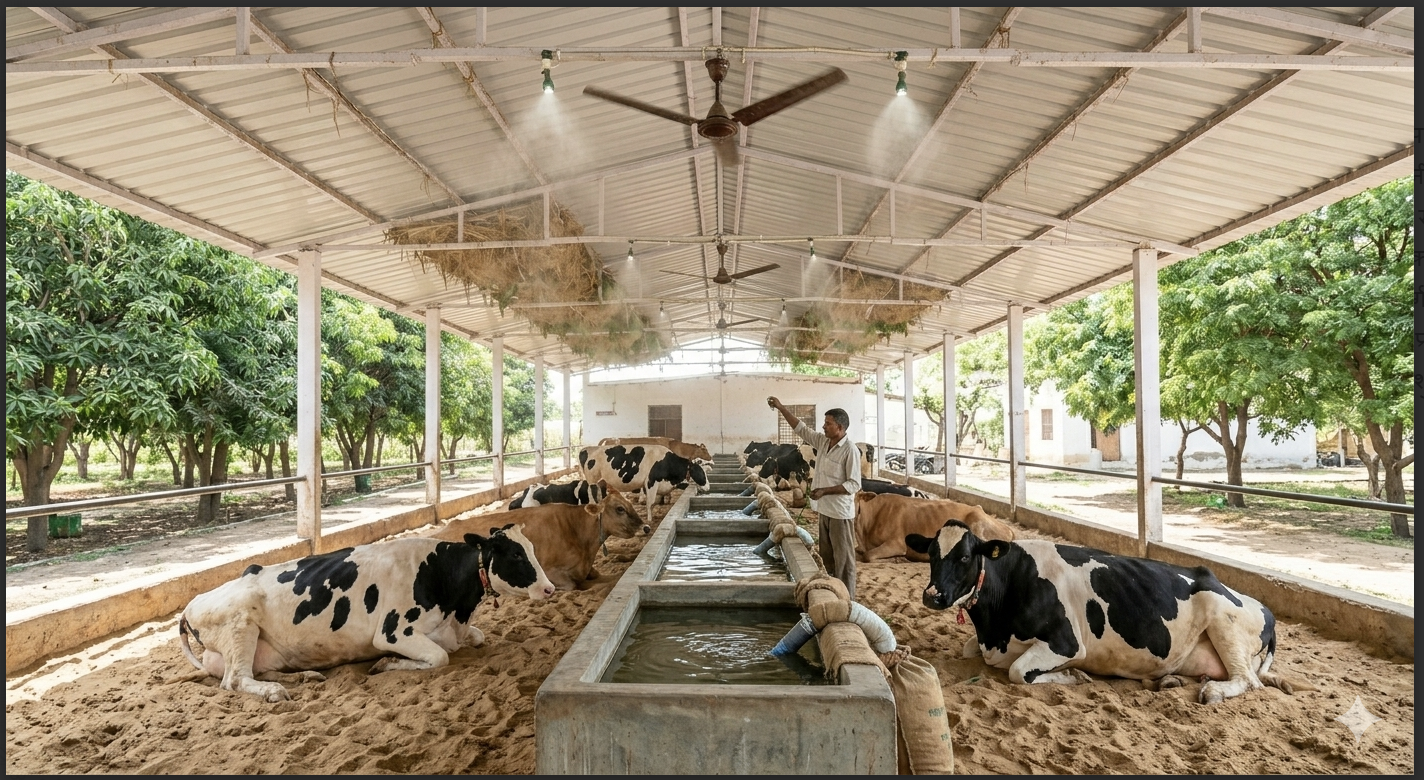
1.Upgraded Management Practices: Management of heat stress by providing shades or cooling during heat waves needs improvement. These will go a long way in cushioning the effects of heat stress. Some changes in feeding schedule with respect to forecast may help improve the intake of nutrition during adverse conditions.
- Vaccination Programs: Before the occurrence of disease the vaccination programs started for common diseases in the population which help to enhance herd immunity in Preventing the incidences of climate-sensitive diseases (Badrudeen et al., 2024).
- Physical modification of environment: Current recommendations suggest a range of
1.2 to 3.6 linear inches (3- 9 linear cm) per cow. In the Midwest, the typically every 10 to 20 cows have one waterer or 2 linear ft (61 cm) of space. similarly, 3.6 linear inches (9 cm) of space for every cow in the pen the recommended in the South- west. The water is provided at each crossover in 4- and 6-row free stall barns. To prevent the cows from direct sunlight exposure Natural shading provided by trees, but most often steel or aluminium are used for shades construction. Using shade cloth or snow fence is not as effective as solid shades because porous and not providing sufficient strength. The hight of shade should be 14 ft (4.3 m). ideally to reduce solar radiation the solid shade per mature dairy cow is 50 ft 2 (4.5 m 2) and the orientation should north-south to prevent wet areas. To reduce the heat low pressure sprinkler/soaker and fan system are used (Smith et al., 2002).
- Nutritional management of heat stress: During climate change the optimum livestock production can be achieved by the ensuring appropriate nutrition to the animal by providing them balanced nutrition which help the animals to ensure optimum reproduction, energy balance and fertility. The animal which is suffering from heat stress should be supplemented 7–25% extra nutrient. In sheep during heat stress betaine, a trimethyl form of glycine, ameliorate are given for feeding.
- Hormonal treatment and assisted reproductive technologies (ART): In Hormonal treatments GnRH administered in the early stages of estrus associated with the endogenous LH surge and improves the conception rate. When GnRH agonist or hCG injection given on the 5th day of the estrous cycle can cause ovulation or luteinization of the dominant follicle from the first follicular wave. This leads to the formation of an extra corpus luteum (CL), which increases progesterone levels in the blood and helps reduce the negative effects of chronic heat stress.The artificial insemination (AI) programs can also improve fertility during summer when used along with a GnRH injection. GnRH helps in the proper development of the ovulatory follicle. After 7 days, a PGF2α injection is given to regress the CL, which allows the ovulatory follicles to mature completely. A second GnRH injection is then given 48 hours after PGF2α to induce ovulation, and cows are inseminated about 16 hours later to increase the chances of successful conception.
- Climate-Durable Breeding: It is a long-term strategy and require more time and precision. To overcome the climate change adverse effect or minimise the effect of climate change or for adaptation to climate change the thermo-tolerant animals breeds should be selected. The selection for high milk yield reduced the thermoregulatory range of the dairy cow and resulted in heat stress which has magnified the seasonal depression in fertility. But this is only beneficial when thermo-tolerant animals are able to maintain high productivity along with survivability at high temperature. Cattle with shorter hair, hair of greater diameter and lighter coat colour are more adapted to hot environments (Singh et al., 2021).
- Research Investment: Further research will be required to understand complex interactions of climate variables with disease dynamics in relation to the elaboration of effective mitigation strategies. Investment in technologies like precision agriculture tools will create real-time monitoring of the environmental conditions influencing the health status of the livestock.
8.Policy Frameworks: These strategies should be developed by governments to promote sustainable farming practices that can Stand against the challenges of climate change. All those farmers who adopting climate-smart agriculture should be providing by the incentives which can motivate farmers to invest in technologies and methods that help them adapt effectively (Badrudeen et al., 2024).
Conclusion:
Climate change is a natural phenomenon which disturb the natural ecosystems associated with human activities. This climate change causing adverse effect on animal health, feed and fodder production, water deficiency, causing disease to the animal which directly associated with the reducing productivity in dairy sector and reduced the income generated from dairy sector. The impact of climate change can be reduced by adopting mitigation strategies such as upgraded management practices, vaccination program, Physical modification of environment, Research Investment, Climate- Durable Breeding, Hormonal treatment and assisted reproductive technologies and Nutritional management of heat stress.
Reference:
Azmat H., (2025), Erratic weather, overgrazing and land use change deepen fodder shortage, Mongabay.
Badrudeen T., Kate J. and Adeola O., (2024), Climate Change and Its Impact on Animal Disease Epidemiology and Production Systems, reserachgate.
Brown T., Climate Change, (2025), National Geographic Society
Collier R. J, Baumgard L. H., Zimbelman R. B. and Xiao Y., (2019), Heat stress: physiology of acclimation and adaptation, , Feature Article, (9):1.
Godde C. M., Mason-D’Croz D., Mayberry D. E., Thornton P. and Herrero M., (2021), Impacts of climate change on the livestock food supply chain; a review of the evidence Global Food Security, 28: 100488, https://doi.org/10.1016/j.gfs.2020.100488.
Mosneh A. and Getachew M, (2025), Review on Water Requirement and Utilization in Farm Animal,International Journal of Bioorganic Chemistry, (10)1:15-23 https://doi.org/10.11648/j.ijbc.20251001.12
Perkins M. and Pappas S., Climate change: Facts, news, features and articles about our warming planet, 2026,
Rosa D. R.D., Ferreira N. C. R., Moreira A. N. H., Battisti R., Oliveira C. E A. Casaroli D., Barbari M., Bambi G. and Andrade R. R., Climate Change and State of the Art of the Sustainable Dairy Farming: A Systematic Review, (2025), Animals, 15:2997 https://doi.org/10.3390/ani15202997.
Singh S. P., Kumar A. and Sourya N., (2021), Effects of heat stress on animal reproduction, International Journal of Fauna and Biological Studies, IJFBS 2021; 8(2): 16-20.
Smith J. F. and Harner J. P., (2002), Managing Heat Stress in Dairy Facilities, Dairy Sessions 35:71-76.
Sultana, M. S., Reshma, B. Z., Hasnat, M. K., & Kabir, M. H. (2024). Factors influencing milk production among the dairy farms of Savar Sub-District, Dhaka, Bangladesh. Journal of Scientific Research and Reports, 30(7), 628–634. https://doi.org/10.9734/jsrr/2024/v30i72176
Suresh G. G. T., Harisha M., Ashok M., Rudresh B. H., and Giridhar K. S., (2023), A study on the effectiveness of dairy farming related front-line demonstrations of Krishi Vigyan Kendra Shivamogga on knowledge level of dairy farmers. Journal of Experimental Agriculture International, 45(10), 116–121. https://doi.org/10.9734/jeai/2023/v45i1022 04
Verma D. K., Gautam A., Panwar A. S., Tiwari P., Kakraliya A. L. and Singh S., Climate Resilient Dairy Farming: Prospect and Future Aspect, (2025), J. Exp. Agric. Int., 47(2): 83-94, 2025; Article no.JEAI.131081.