
Digital Veterinary and Livestock Management Systems in Rural India
DR HITENDRA KUMAR SONI,SENIOR VETERINARY OFFICER
GOVT OF CHHATTISGARH
Introduction: –
Where the world is going forward with AI and digital data base in each sector of progress of New India, how the impact of digitalization would impact animal husbandry and veterinary practices? There are many cloud based and system-based application available to gather and transmit the health records and other for pets, there is availability of many apps for the large animals too. Even there is a groundbreaking, government-led digital ecosystem designed to transform India’s veterinary and livestock sector. It functions as a comprehensive, nationwide digital database connecting livestock owners, field workers, and veterinarians to enhance animal productivity, improve breeding, and strengthen disease surveillance called “Bharat Pashudhan,” (earlier it was INAPH).
As of late 2025, the system has registered over 35.96 crore animals, commonly known as “Pashu Aadhaar,” utilizing a 12-digit barcoded ear tag as a unique digital identity.
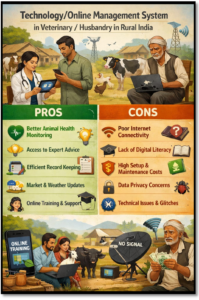
Online systems in animal husbandry are transforming rural India by improving disease monitoring, market access, and farmer education, but challenges like poor internet connectivity, digital literacy gaps, and high setup costs limit their effectiveness.
Current Technology in Veterinary Medicine
- Disease Monitoring & Control
- Platforms like the National Digital Livestock Mission (NDLM)provide real-time disease tracking, vaccination records, and early warning systems.
- Helps prevent outbreaks such as foot-and-mouth disease, which can devastate rural economies.
- Advanced imaging (MRI, CT scans, ultrasound) allows precise detection of diseases.
- AI-powered diagnostic tools help veterinarians make quicker, more accurate decisions.
- Market Access & Transparency
- Farmers can sell milk, meat, and livestock through online marketplaces, reducing dependence on middlemen.
- Digital records make animals “bankable assets,” enabling loans and insurance.
- Knowledge & Advisory Services
- Expert systems (e.g., TNAU Cattle Expert System) provide farmers with guidance on feeding, breeding, and disease management.
- Online training improves awareness of modern practices.
- Telemedicine
- Remote consultations expand access to veterinary care, especially in rural areas.
- Farmers and pet owners can get expert advice without traveling long distances.
- Data-Driven Productivity
- Digital tools track animal health, milk yield, and breeding cycles, helping farmers optimize production.
- Precision livestock farming reduces costs and improves animal welfare.
- Wearable devices track animal health in real time (temperature, heart rate, activity).
- Cloud-based systems streamline patient records and improve continuity of care.
- Enhanced Animal Welfare
Technology helps detect pain, stress, or illness earlier, improving quality of life.
Precision livestock farming ensures better productivity and humane treatment.
- Government Schemes &Subsidies: –Online systems streamline access to subsidies, vaccination drives, and welfare programs.
- Farmers can register livestock digitally, ensuring inclusion in official schemes.
Technology is transforming veterinary medicine by making care more precise, accessible, and humane. However, cost, training, and ethical challenges remain significant barriers, especially in regions like rural India where affordability and infrastructure are limited. The best path forward is balanced adoption—leveraging technology where it adds clear value while maintaining traditional veterinary expertise.
National Digital Livestock Mission (NDLM)
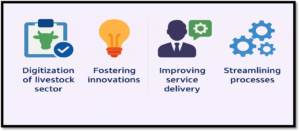
The Department of Animal Husbandry and Dairying, Government of India has launched the National Digital Livestock Mission (NDLM) for creating a digital database of livestock and related services across the country. In India most of the livestock is held by small and marginal farmers and are scattered across all villages due to which targeting market mechanisms and service delivery mechanisms in India is much more challenging. Therefore, in order to tap the full potential of the sector and to help in planning schemes and programmes for the sector a technology enabled farmer centric digital ecosystem has been developed by the Department of Animal Husbandry and Dairying (DAHD) under the project name “Bharat Pashudhan”.
Major objectives of NDLM:
(i) Breed Improvement: With the integrated systems it would be possible to create/manage breeding activities for achieving the best quality germplasm that is appropriate for various agroclimatic conditions of India.
(ii) Disease Monitoring and Control: In order to have an overview of Livestock animal disease status an integrated Disease monitoring and control system that can prevent, predict, respond and treat major diseases that affect animals is a part of this project.
(iii) Product Traceability: With integration of Tag-IDs, geographical locations, processing facilities a fool proof traceability system for livestock products is being made as a part of NDLM involving all the stakeholders. The traceability aspect will provide opportunities for branding of products, exploring new markets.
(iv) Farmer centric Ecosystem: Primary aim is to empower the Farmers by providing them information for fully utilizing Government facilities, schemes and avail the services required for the livestock.
(v) Open-source Architecture and API enabled environment: This Database has been build up on open-source architecture so that it can be integrated with any system. All stakeholder groups like Financing institutions, Insurance sector, private practitioners and other organizations working in this field can be integrated in this system for seamless information exchange across the sector.
A Mobile application as well as web interfaces have been made named as, “Bharat Pashudhan” an Android based application, available on Google Play store for the use of field workforce for recording the field activities. In Bharat Pashudhan a unique ID in the form of 12-digit bar coded ear tag is being issued to all livestock animals. Utilizing this Tag ID as a primary key field workers record information from the field in respect of every animal like, Animal registrations, Artificial inseminations and all breeding activities, Change in ownership, Vaccinations, E-prescriptions, Ration balancing, Disease reporting, milk recording, etc. The system has been implemented in all States successfully.
Statistical Highlights of Bharat Pashudhan as on date:
- Livestock Owners Registered 9.5 Crores
- Pashu Aadhar Registered 35.96 Crores
- Field Workers User IDs Issued 4 Lakhs
- Vaccination records entered in systems are 146.6 crores
- All type of transactional records available in Bharat Pashudhan 250 Crores
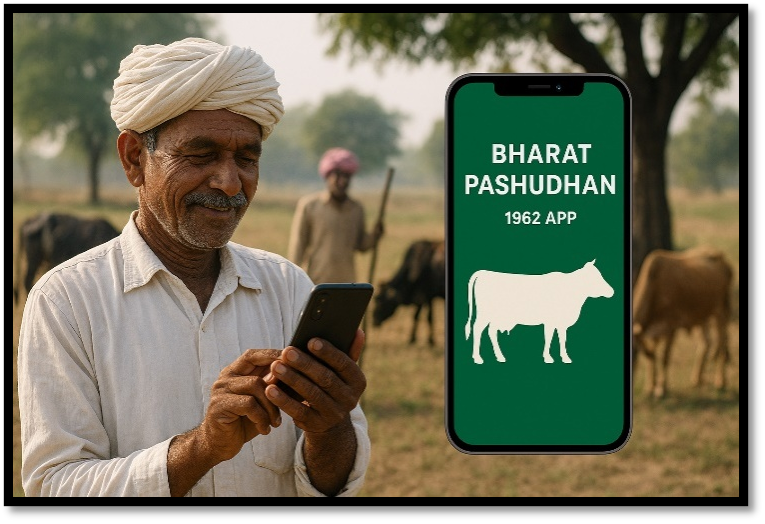
Further, one of the objectives of Bharat Pashudhan initiative is to empower farmers with information about their animals, schemes and facilities available for them in Livestock sector. In order to fulfil this objective 1962 – Livestock owner app has been developed. This app is connected to NDLM database for providing information to livestock owner about his/her animals registered and is also connected with DAHD website to provide latest information about Ministry’s schemes/programmes available for the Livestock owners.
Bharat Pashudhan Platform –
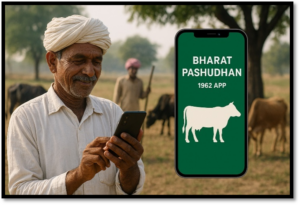
- It is a unified digital database that integrates animal health, breeding, and productivity data.
- It integrates livestock data nationwide through the Bharat Pashudhan platform (mobile and web).
- Pashu Aadhaar –Every animal is issued a unique 12-digit barcoded ear tag (digital identity) that links to breeding, vaccination, ownership, and health records.
- As of December 2025, approximately 35.96 crore animals have been issued these IDs.
Farmer Empowerment Tools –
- Bharat Pashudhan App –It is used by field workers to record activities such as artificial insemination, vaccinations, and e-prescriptions.
- 1962 Livestock Owner App– It replaced the earlier e-Gopala app, allowing farmers to view their animals’ records and track health ser
It is linked directly to the NDLM database shows details of registered animals, latest schemes/programmes from DAHD, and is integrated with flagship programmes like Rashtriya Gokul Mission (RGM), etc.
Drawbacks & Challenges in rural area
High Costs
- MRI machines, robotic systems, and AI tools are expensive, making them unaffordable for small clinics.
- Farmers in developing regions may struggle to adopt advanced monitoring systems.
- Training & Skill Gaps
- Veterinarians need specialized training to use complex technologies effectively.
- Risk of misdiagnosis if tools are used incorrectly.
Over-Reliance on Technology
- Excessive dependence may reduce traditional diagnostic skills and hands-on experience.
- Technical failures can delay treatment.
Ethical Concerns
- Use of AI and robotics raises questions about animal autonomy and humane treatment.
- Data privacy issues with cloud-based systems storing sensitive farm or pet information.
Accessibility Issues
Rural and low-income regions may not benefit equally, widening the gap in veterinary care.
Connectivity Issues
- Rural India still faces patchy internet coverage, limiting access to online platforms.
- Farmers in remote villages may be excluded.
- In current scenario worker has to be include digitalization of ADHAR and OTP verified animal owner, which is a big trouble due to digital fraud and owner do not trust provide these, even supreme court exempted adhar no verification in govt schemes.
- Due to patchy internet and App working issues I became more problematic as app many times do not support updating of adhar and delayed OTP delivery make it more hectic to make it digital.
Digital Literacy Gap
- Animal owner especially in rural sector are not ready to share their adhar and OTP with any one.
- Many small-scale farmers lack the skills to use apps or online systems effectively.
- Training programs are needed but often underfunded.
Cost Barriers
- Smartphones, data plans, and digital infrastructure require investment that poorer farmers may struggle to afford.
- Devices, training, and data plans add financial burden for smallholders.
Data Privacy & Trust
- Farmers worry about misuse of livestock data by corporations or government agencies, especially in the current world scenario of digital fraud.
- Lack of transparency can reduce adoption.
- Due to presence of private players in Artificial insemination worker and ease of availability of Semen and Ln2, govt employees lacking their base in animal owners as the private players do not have digital documentation priorities which is in govt sector.
- Unequal Benefits
- Larger commercial farms benefit more than smallholders, widening the rural income gap.
Digital Divide
- Rural farmers in states like Chhattisgarh often lack smartphones or internet access.
- Digital literacy gaps make adoption difficult.
Infrastructure Challenges
- Patchy connectivity in villages limits real-time data entry.
- Dependence on field workers creates bottlenecks.
Conclusion
Online systems in animal husbandry hold huge promise for rural India, especially in states like Chhattisgarh where livestock is central to livelihoods. They can boost productivity, reduce disease losses, and empower farmers economically, but without better internet infrastructure, affordable devices, and farmer training, the benefits will remain uneven.
NDLM is a gamechanger for livestock management in India and Chhattisgarh. It promises better disease control, productivity, and financial empowerment, but its success depends on bridging the digital divide, improving rural connectivity, and building farmer trust.