



Principles and Practices of Bio-security in Commercial Poultry Farms: A Comprehensive Review
Rishi Kumar*
Division of Livestock Products Technology, ICAR- Indian Veterinary Research Institute, Izatnagar, Bareilly, Uttar Pradesh, India, 243122
*Corresponding author Name & Email:chaudharyrishi005@gmail.com
Abstract
Bio-security represents a critical component of modern poultry production systems, encompassing a comprehensive set of preventive strategies aimed at minimizing the introduction and spread of infectious diseases. The rapid intensification of poultry farming, particularly in developing countries, has significantly increased the risk of trans boundary and endemic diseases such as highly pathogenic avian influenza (HPAI), Newcastle disease (ND), and infectious bursal disease (IBD). These diseases pose serious threats to animal health, food security, and global trade.
Recent epidemiological studies indicate that inadequate implementation of bio-security measures remains a major determinant of disease outbreaks in commercial poultry farms. This review provides an in-depth analysis of bio-security principles, including isolation, traffic control, and sanitation, along with their practical applications in poultry production systems. The article further evaluates external and internal bio-security strategies, disease surveillance, vaccination protocols, and environmental management.
Emerging technologies such as artificial intelligence (AI), precision livestock farming (PLF), genomic surveillance, and blockchain-based traceability systems are also discussed as transformative tools for improving bio-security compliance and disease monitoring. The review highlights key challenges, including economic constraints, lack of awareness, and poor compliance, particularly in developing regions.
Finally, the integration of bio-security within a One Health framework is emphasized as essential for sustainable poultry production, reduction of antimicrobial resistance, and protection of public health.
Keywords
Bio-security; Poultry farming; Avian influenza; Newcastle disease; One Health; Antimicrobial resistance; Precision livestock farming
- Introduction
The poultry sector is among the fastest-growing segments of global livestock production, driven by increasing demand for affordable and high-quality protein sources. According to the Food and Agriculture Organization (FAO, 2023), poultry plays a pivotal role in ensuring global food security and supporting rural and urban livelihoods. In India and other developing countries, rapid industrialization of poultry farming has resulted in the expansion of high-density, intensive production systems, which are inherently more susceptible to infectious disease outbreaks. The 20th Livestock Census (2019) reported that India’s total poultry population reached 851.81 million birds, indicating consistent growth in both broiler and layer sectors. Furthermore, according to the Basic Animal Husbandry Statistics (BAHS, 2026), the country’s egg production has surpassed 149.11 billion annually, while poultry meat contributes approximately 49% of the total meat production in India, thereby highlighting the substantial economic importance of the poultry sector. However, this rapid growth, coupled with increased farm density and intensified production practices, has amplified the risk of pathogen transmission, thereby necessitating the implementation of stringent and scientifically grounded biosecurity measures.
Diseases such as avian influenza (AIV), Newcastle disease virus (NDV), and bacterial infections like Salmonella and Campylobacter have caused severe economic losses and public health concerns worldwide (Dhingra et al., 2018; WHO, 2022). These pathogens spread rapidly in intensive production systems due to increased contact rates and environmental contamination.
Bio-security is defined as a set of preventive measures designed to reduce the risk of transmission of infectious agents. It is widely recognized as the most cost-effective strategy for disease prevention in poultry farming (FAO, 2023). This review aims to critically examine biosecurity principles, practices, challenges, and emerging innovations in commercial poultry production.
2. Concept and Principles of Bio-security
Bio-security is based on epidemiological principles that aim to interrupt the chain of infection involving the pathogen, host, and environment. It includes two major components:
- Bio-exclusion:Preventing pathogen entry into the farm
- Bio-containment:Preventing pathogen spread within and beyond the farm
2.1 Core Principles
2.1.1 Isolation (Segregation)
Isolation involves the physical separation of poultry from potential sources of infection. This is achieved through:
- Establishment of secure farm boundaries with fencing
- Controlled access points with restricted entry
- Maintenance of adequate distance between poultry farms
- Prevention of contact with wild birds, rodents, and other animals
Wild birds are recognized as natural reservoirs for avian influenza viruses, making their exclusion critical in preventing disease introduction.(OIE, 2022).
2.1.2 Traffic Control
Traffic control regulates the movement of people, vehicles, and equipment that may act as mechanical vectors for disease transmission. Key measures include
- Restricting non-essential visitors
- Maintaining visitor logs and biosecurity records
- Providing farm-specific clothing and footwear
- Implementing downtime periods for personnel visiting multiple farms
- Disinfecting vehicles and equipment before entry
Human activity represents a major pathway for the introduction of pathogens, particularly in regions with high poultry farm density. The implementation of strict visitor restrictions, maintenance of entry records, and adherence to standardized sanitation protocols can substantially reduce the risk of disease transmission (Dorea et al., 2010)
2.1.3 Sanitation
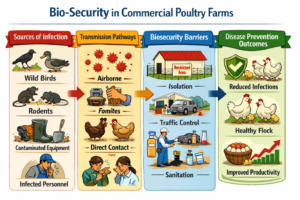
Sanitation focuses on reducing pathogen load in the farm environment. This includes:
- Routine cleaning and disinfection of poultry houses
- Use of effective disinfectants (e.g., quaternary ammonium compounds, formaldehyde, iodine-based solutions)
- Proper disposal of dead birds through incineration or deep burial
- Treatment of drinking water (chlorination, filtration)
- Maintenance of feed hygiene to prevent contamination
Effective sanitation plays a crucial role in interrupting indirect transmission pathways, including those involving fomites and environmental reservoirs. The use of appropriate disinfectants, along with scientifically managed waste disposal practices, constitutes an essential component of comprehensive sanitation programs (McDonnell & Russell, 1999).
Fig 1: Bio-security in Commercial Poultry Farms
- Bio-security Practices in Commercial Poultry Farms
3.1 External Bio-security
External bio-security prevents pathogen entry:
| Measure | Description |
| Farm fencing | Restricts unauthorized access |
| Footbaths | Disinfect footwear |
| Vehicle dips | Prevent pathogen entry via transport |
| Certified hatcheries | Ensure disease-free chicks |
| Quarantine | Isolate new birds |
3.2 Internal Bio-security
Internal bio-security prevents disease spread:
| Measure | Description |
| All-in all-out system | Reduces cross-contamination |
| Age segregation | Prevents disease transmission |
| Dedicated equipment | Limits pathogen transfer |
| Isolation of sick birds | Controls outbreaks |
3.3 Environmental Management
- Periodic litter replacement and proper litter treatment
- Maintenance of optimal ventilation to reduce aerosol transmission
- Provision of potable water (chlorination or UV treatment)
- Regular sanitation of feeders and drinkers
Environmental contamination is a key factor in disease persistence (Jones et al., 2021).
3.4 Disease Surveillance
- Routine serological and molecular diagnostic testing
- Syndromic surveillance and early warning systems
- Digital record-keeping for traceability
- Immediate reporting to veterinary authorities: Early detection significantly reduces outbreak severity (FAO, 2023).
National frameworks such as India’s Poultry Disease Action Plan (2024) emphasize surveillance as a cornerstone of outbreak prevention.
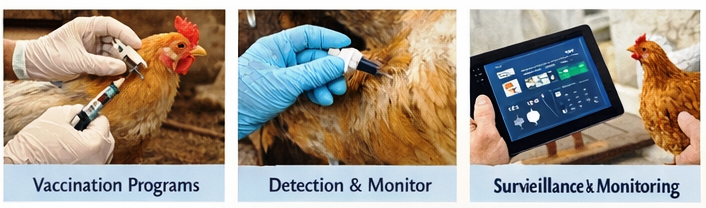
3.5 Vaccination Programs
Vaccination complements bio-security:
- Development of region-specific vaccination schedules
- Maintenance of cold chain for vaccine efficacy
- Use of advanced vaccines (e.g., recombinant, vector-based, DIVA vaccines)
- Monitoring post-vaccination immunity
Vaccination reduces disease burden but does not replace bio-security (Swayne et al., 2020).
Fig. 2. Disease Prevention Strategies in Poultry Farming (source: ICAR manual)
- Epidemiological and Economic Importance of Bio-security
Bio-security plays a critical role in ensuring the sustainability and profitability of poultry farming.
4.1 Disease Prevention
Bio-security reduces the likelihood of disease outbreaks by limiting pathogen exposure. Studies have shown that farms with strict bio-security measures have significantly lower disease incidence (Laanen et al., 2013).
4.2 Economic Benefits
Disease outbreaks result in high mortality, reduced productivity, and trade restrictions. Effective bio-security minimizes these losses, improved feed conversion ratio (FCR), and improves farm profitability.
4.3 Public Health Protection
Poultry products can serve as sources of zoonotic pathogens such as Salmonella and Campylobacter. Bio-security reduces contamination and enhances food safety (WHO, 2022).
4.4 Reduction of Antimicrobial Resistance
Improved bio-security reduces the need for antibiotics, thereby mitigating the development of AMR a major global health concern (Van Boeckel et al., 2015).
Epidemiological studies consistently demonstrate that farms with stringent bio-security protocols exhibit significantly lower outbreak frequencies and improved flock performance.
- Challenges in Implementation
Despite the well-documented benefits of bio-security in poultry production, its effective implementation remains constrained by several interrelated factors, particularly in developing countries. These challenges often limit the adoption, consistency, and overall effectiveness of bio-security measures at the farm level.
One of the primary barriers is economic constraints, as the establishment and maintenance of bio-security infrastructure such as fencing, disinfection units, and controlled housing systems require substantial financial investment. This is particularly challenging for small- and medium-scale farmers, who may lack the necessary resources to implement comprehensive bio-security protocols.
Another significant limitation is the lack of awareness and technical knowledge among poultry farmers. Inadequate understanding of disease transmission pathways and bio security principles often leads to improper or incomplete implementation of preventive measures. This knowledge gap is further exacerbated by limited access to extension services and training programs.
Behavioral factors also play a critical role in influencing bio security compliance. Even when farmers are aware of recommended practices, inconsistent adherence to protocols such as neglecting sanitation procedures or allowing unauthorized farm access can compromise the effectiveness of bio-security systems.
In addition, structural limitations, including high farm density and close proximity between poultry operations, increase the risk of disease transmission. In such settings, pathogens can spread rapidly through airborne routes, shared resources, or human-mediated contact.
Furthermore, the presence of informal and unregulated poultry trade systems contributes significantly to disease dissemination. The uncontrolled movement of birds, equipment, and poultry products without proper health certification or bio security checks facilitates the spread of infectious agents across regions.
Collectively, these challenges result in partial or inconsistent implementation of bio-security measures, which substantially reduces their overall effectiveness. Studies have demonstrated that incomplete adoption of bio-security practices fails to provide adequate protection against disease outbreaks (Laanen et al., 2013).
- Emerging Trends and Technological Innovations in Poultry Bio-security
Recent technological advancements are significantly transforming bio-security management in commercial poultry production systems. These innovations enable real-time monitoring, early disease detection, improved traceability, and enhanced decision-making, thereby strengthening the overall effectiveness of bio-security protocols.
6.1 Precision Livestock Farming (PLF)
Precision Livestock Farming (PLF) refers to the application of advanced sensor-based technologies and automated systems to monitor animal health, behavior, and environmental conditions in real time. In poultry production, PLF systems utilize sensors to continuously measure parameters such as temperature, humidity, ammonia levels, feed and water intake, and bird movement patterns.
These data are integrated into centralized platforms, allowing farmers to detect deviations from normal conditions that may indicate stress or early stages of disease. For example, reduced feed intake or abnormal activity levels can serve as early warning indicators of infection. By enabling timely interventions, PLF enhances disease prevention, improves animal welfare, and reduces economic losses. Furthermore, PLF contributes to optimizing resource utilization and maintaining consistent production efficiency.
6.2 Artificial Intelligence (AI)
Artificial Intelligence (AI) is increasingly being integrated into poultry bio-security systems to facilitate early and accurate disease detection. AI-driven tools employ machine learning algorithms, computer vision, and acoustic analysis to identify subtle changes in bird behavior, posture, and vocalization patterns.
Image-based AI systems can detect clinical signs such as lameness, lethargy, or abnormal posture, while sound analysis technologies can identify respiratory distress or distress calls associated with specific diseases. These systems can process large datasets rapidly and provide predictive insights, enabling proactive disease management.
The integration of AI with surveillance systems enhances diagnostic accuracy and reduces reliance on manual observation, which is often subjective and time-consuming. As a result, AI has the potential to revolutionize disease monitoring and significantly strengthen farm-level bio-security.
6.3 Blockchain Technology
Blockchain technology is emerging as a powerful tool for improving transparency, traceability, and accountability in poultry supply chains. It operates as a decentralized digital ledger that records transactions in a secure and immutable manner.
In poultry production, blockchain can be used to track the movement of birds, feed, vaccines, and other inputs from farm to market. This ensures complete traceability of poultry products and facilitates rapid identification of contamination sources during disease outbreaks.
By enhancing data integrity and transparency, blockchain systems build consumer trust and support compliance with food safety regulations. Additionally, they enable more efficient disease surveillance and response by providing real-time access to supply chain data.
6.4 Genomic Surveillance
Genomic surveillance involves the use of advanced molecular techniques, such as whole-genome sequencing, to monitor the evolution and spread of pathogens. In poultry systems, genomic tools are increasingly used to identify genetic variations in viruses and bacteria, track transmission pathways, and detect emerging strains with increased virulence or resistance.
This approach provides critical insights into disease epidemiology, enabling targeted interventions and more effective vaccine development. For instance, genomic analysis of avian influenza viruses can help predict outbreak patterns and guide control strategies.
The integration of genomic surveillance into biosecurity frameworks enhances the ability to respond to emerging disease threats and supports evidence-based decision-making.
6.5 Smart Disinfection Systems
Smart disinfection systems represent an advancement in sanitation technology, incorporating automation and precision in cleaning and disinfection processes. These systems use programmable devices, sensors, and controlled-release mechanisms to ensure optimal application of disinfectants.
Automated disinfection units can regulate factors such as concentration, contact time, and coverage, thereby improving the efficacy of sanitation protocols. Some systems also integrate with environmental sensors to trigger disinfection cycles based on contamination levels or risk factors.
By reducing human error and ensuring consistency, smart disinfection technologies significantly enhance hygiene standards and reduce pathogen persistence within poultry environments.
- One Health Approach
Bio-security is closely aligned with the One Health approach, as it addresses the interconnectedness of animal, human, and environmental health. By implementing effective bio-security measures in poultry production systems, the risk of zoonotic disease transmission from animals to humans is significantly reduced. Additionally, these practices contribute to improved food safety by minimizing contamination of poultry products with pathogenic microorganisms. Furthermore, bio-security plays an essential role in protecting ecosystems by limiting the spread of infectious agents and reducing environmental pollution associated with improper waste management. Thus, bio-security serves as a critical link in promoting sustainable and holistic health outcomes within the One Health framework
- Conclusion
Bio-security constitutes a fundamental pillar of sustainable poultry production systems. Its effective implementation plays a critical role in minimizing disease risks, improving flock health and productivity, and ensuring the safety and quality of poultry-derived food products. Despite its well-established benefits, significant challenges persist, particularly in developing countries, where limitations in infrastructure, awareness, and compliance hinder optimal adoption. Addressing these constraints requires a coordinated and multidisciplinary approach involving strengthened policy frameworks, targeted farmer education and capacity-building programs, and the integration of advanced technological innovations. Such efforts are essential to enhance bio-security compliance and ensure the long-term sustainability and resilience of the poultry sector
- Future Directions
Future advancements in poultry bio-security should prioritize the development and adoption of innovative, scalable, and sustainable strategies. The application of artificial intelligence (AI) based disease monitoring systems has the potential to significantly enhance early detection and rapid response to emerging disease threats. In parallel, the design and implementation of cost-effective bio-security models are essential to ensure wider adoption, particularly among small- and medium-scale poultry producers. Strengthening regulatory frameworks, along with strict enforcement of bio-security standards, will further improve compliance and reduce the risk of disease outbreaks.
Capacity building through structured farmer training programs and extension services is equally critical to bridge knowledge gaps and promote best management practices at the farm level. Moreover, integrating bio-security measures within the One Health framework will facilitate a more comprehensive approach by addressing the interconnectedness of animal, human, and environmental health. Collectively, these strategies will contribute to building a more resilient, sustainable, and disease-resistant poultry production system.
References
- 20th livestock census 2019: All India report. Ministry of Fisheries, Animal Husbandry and Dairying, Department of Animal Husbandry and Dairying. https://dahd.nic.in
- Alexander, D. J. (2007). An overview of avian influenza. Vaccine, 25(30), 5637–5644. https://doi.org/10.1016/j.vaccine.2006.10.051
- Basic animal husbandry statistics 2026. Ministry of Fisheries, Animal Husbandry and Dairying, Department of Animal Husbandry and Dairying. https://dahd.nic.in
- Dhingra, M. S., Artois, J., Dellicour, S., et al. (2018). Geographical and historical patterns of avian influenza. Transboundary and Emerging Diseases, 65(1), e19–e32. https://doi.org/10.1111/tbed.12724
- (2023). Biosecurity guide for poultry production.
- Government of India. (2025). Poultry sector report.
- Jones, B. A., Grace, D., Kock, R., et al. (2021). Zoonosis emergence linked to agriculture. Nature, 451, 990–993. https://doi.org/10.1038/nature06536
- Laanen, M., Persoons, D., Ribbens, S., et al. (2013). Biosecurity and production. Preventive Veterinary Medicine, 109, 186–195. https://doi.org/10.1016/j.prevetmed.2012.10.001
- McDonnell, G., & Russell, A. D. (1999). Disinfectants and resistance. Clinical Microbiology Reviews, 12(1), 147–179. https://doi.org/10.1128/CMR.12.1.147
- Racicot, M., Venne, D., Durivage, A., & Vaillancourt, J. P. (2012). Biosecurity compliance study. Preventive Veterinary Medicine, 103(1), 23–30. https://doi.org/10.1016/j.prevetmed.2011.08.011
- Sharma, J. M. (2021). Biosecurity in poultry production. Journal of Poultry Science, 58(2), 123–135.
- Singh, R., & Kumar, P. (2024). Advances in poultry health management. Veterinary World, 17(1), 45–52
- Swayne, D. E., Suarez, D. L., & Sims, L. D. (2020). Avian influenza vaccines. Avian Diseases, 64(1), 1–5. https://doi.org/10.1637/aviandiseases-D-19-00142
- Van Boeckel, T. P., et al. (2015). Antimicrobial use in livestock. PNAS, 112(18), 5649–5654. https://doi.org/10.1073/pnas.1503141112
- (2022). Zoonoses and food safety.
- WOAH (OIE). (2022). Terrestrial Animal Health Code.















