

Infectious coryza (IC) coupled with multiple nutritional deficiencies in a Duck flock
D T Naik 1, Rajendra kumar T2, Shazaan Murtaza3 and Sandeep biradar4
Department of veterinary Pathology, Veterinary College, Bidar- 585401, Karnataka, India
- Prof & Head 2. Associate Prof
Infectious coryza (IC) is an acute, highly contagious disease of upper respiratory tract of ducks caused by Haemophilus paragallinarum which is a normal inhabitant of respiratory tract especially upper part (Vegad and Katiyar, 2005). ducks of all ages are susceptible, but older birds react more severely. The disease causes economic losses due to increased culling in growing and reduced egg production in ducks (loc cited, 2005). A deficiency of Vitamin D causes hypocalcemia and hypophosphatemia (Low blood phosphorus) in which skeletal mineralization becomes defective giving rise to rickets in young ones (reduced bone mineral deposition) and osteomalacia (bone mineral loss) in adult birds (loc cited, 2005). Rachitic deformities develop and occasionally enlargement of costo-chondral junctions in rickets (loc cited, 2005). Nutritional deficiency, especially vitamin D along with deficiency of minerals like calcium and phosphorus are the causes of rickets or osteomalacia (Ganti sastry, 2001).
Common feed ingredients contain a little or no Vitamin D, hence it should be incorporated in the feed, in combination with proper supplementation of minerals like calcium and phosphorous (Vegad, 2018 ). Vitamin E is an important antioxidant preventing the diseases of brain, muscle and fat (loc cited, 2005). Deficiency of Vitamin E is responsible for nutritional myopathy (loc cited, 2005). Vitamin A is essential for the normal maintenance of epithelial tissues in adults and for bone growth in young ones, by maintaining epithelial surfaces, thus protecting the body from infections and is also known as anti-infectious vitamin (loc cited, 2001). The major target of Vit A is the eye (J. L. Vegad, 2018 ).
The present study describes , infectious coryza (IC) along with deficiency diseases especially of Vit D, Vit A, E and minerals like calcium and phosphorous .
There was a mortality of ducks of 6 months age, in Livestock farm complex, Veterinary college, Bidar dist, Karnataka. The representative samples of carcasses of duck was brought to the department of Veterinary Pathology, Veterinary College, Bidar for postmortem examination. The ducks were maintained in shed and were placed in a large cage during night hours. The birds were fed concentrates procured from local feed manufacturing companies. Vaccination of Lasota strain was also conducted.
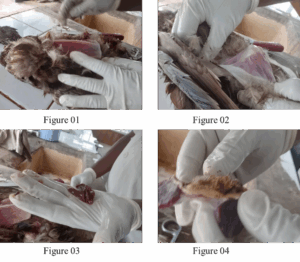
Externally, all carcasses appeared weak and emaciated ( Fig 01). According to owner, respiratory distress was prominent.
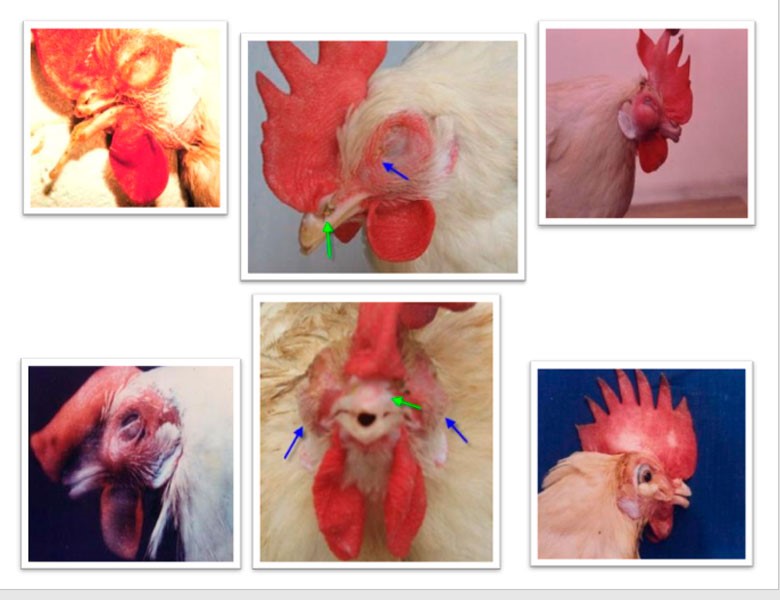
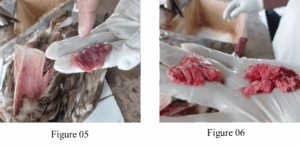
On opening of carcass, severe atrophy of breast muscles with crooked sternum (fig 01). Enlargement of costo-chondral junction was also evident assuming beated appearance (fig 02). Associated lesions were atrophy of liver and congested(fig 03). Proventriculus showed catarrh (Fig 04). Added to above lesions, severe atrophy of breast muscle with inflammatory changes along with whitish discoloration of gizzard musculature as well as cardiac muscle was evident (fig 04 & 05). Both the lungs were severely congested with haemorhages and patchy consolidation (fig 06). Kidneys were pale and at times they were congested and oedematous. The lesions of enlarged eye balls covered with inspissated cheesy exudate coated with oedema of eyes were indicative of Vitamin A deficiency. Characteristic feature of severe atrophy of breast muscles, gizzard and cardiac muscle may be suggestive of Vit E deficiency which can be referred to nutritional myopathy. Severe congestion of lungs accompanied by oozing of mucopurulent nasal discharge can be attributed to infectious coryza (IC). However, causative agent of IC was not isolated and identified. The beaded appearance of costo-chondral joints and cooked sternum was indicative of Vit D deficiency and deficiency of calcium and phosphorous. Considering all the above lesions the present investigation can be concluded as infectious coryza (IC), Vit A, D & E deficiency along with deficiency of calcium and phosphorus.
The lesions listed above were purely based on pathomorphological changes noticed in duck bird carcasses. In order to prevent these conditions proper supplements of vitamins like Vitamin A, D & E and minerals like calcium, phosphorus along with suitable antibiotics and respiratory stimulants to prevent the infectious diseases like infectious coryza (IC) in the duck farm. Added to this, as a managemental practice, of feeding of duck birds ration containing high percentage of unsaturated fatty acids especially that destroy vitamin E or feeding with fish meat and bone meal containing sodium bisulphite can safely be avoided to eliminate the possibility of especially of Vit E deficiency in the duck flock (Ganti sastry, 2001)
To conclude the Vitamin deficiencies like Vit A, E and D and minerals like calcium and phosphous might have acted as stress factors or predisposing factors stimulating the proliferation of Haemophilus paragallinarium causing infectious coryza (IC) in the duck farm.
Acknowledgement
We are very much indebted to the Dean of Veterinary college Bidar for providing necessary facilities to carry out the above investigation.
References
- Ganti A sastry. 2001. Textbook of veterinary pathology, revised and enlaregd by p. rama rao, CBS publishers & distributors pvt.ltd. new delhi
- J L Vegad and katiyar (2005). Second reprint September. A textbook of veterinary special pathology, infectious diseases of livestock and poultry. International book distributors and co, lucknow, India
- J L Vegad and katiyar (2018). Second reprint September. A textbook of veterinary special pathology, infectious diseases of livestock and poultry. International book distributors and co, lucknow, India