

Feeding the Future: Efficient Silage Making Methods for Smarter Farming
Pooja Tamboli, K. K. Singh and Amit Kumar Chaurasiya
Plant Animal Relationship Division ,Indian Grassland and Fodder Research Institute
Jhansi- 284 003 (U.P.), India
India is basically an agrarian country with a large livestock population, making the dairy and livestock industry an important subsidiary occupation of farmers. It contributes to the economy of the country by providing milk, meat, wool, etc. India has recently emerged as the largest producer of milk in the world, but livestock productivity is very low as compared to the developed countries. Low productivity of the animals is ascribed chiefly to an inadequate supply of nutrients. Both quantitatively and qualitatively, there exists a huge gap in availability and supply of feed nutrients, which is further compounded during lean and scarcity periods (Singh and Mojumdar, 1992). Poor supply of nutrients to livestock during scarcity periods is a matter of concern. So, there is an urgent need for preservation of nutrients from forages, including fodder tree leaves, available during the flush period for feeding livestock during the lean period (Mahanta and Pachauri, 2005).
India being a tropical monsoon-bound country, a large quantity of surplus Kharif forages is produced, which are frequently in excess of need. It is therefore essential to preserve the nutrients available from excess forage during both the Kharif and Rabi seasons at the proper stage of maturity to provide nutrients during lean periods. Poor nutritional support during scarcity also caused adverse effects on dairy animals, which included poor fertility and reproductive function, breeding cover, bovine population, and draft energy. Successful animal production requires an adequate supply of nutrients throughout the year. The nutrients from forage can be preserved either as silage, hay, or high-temperature dehydration. There is high energy output in high-temperature dehydration and therefore it cannot be termed as economically feasible. Forage can be profitably preserved either as silage or hay for providing nutrients during scarcity. Besides hay and silage, attempts have also been made to preserve the nutrients, particularly protein, in the form of leaf meal from the leguminous forages, such as Lucerne, Stylosanthes, etc., and leguminous top feed, such as Leucaena, Sesbania, Gliricidia, etc.
Ensilage- a potential mean of preservation of nutrients
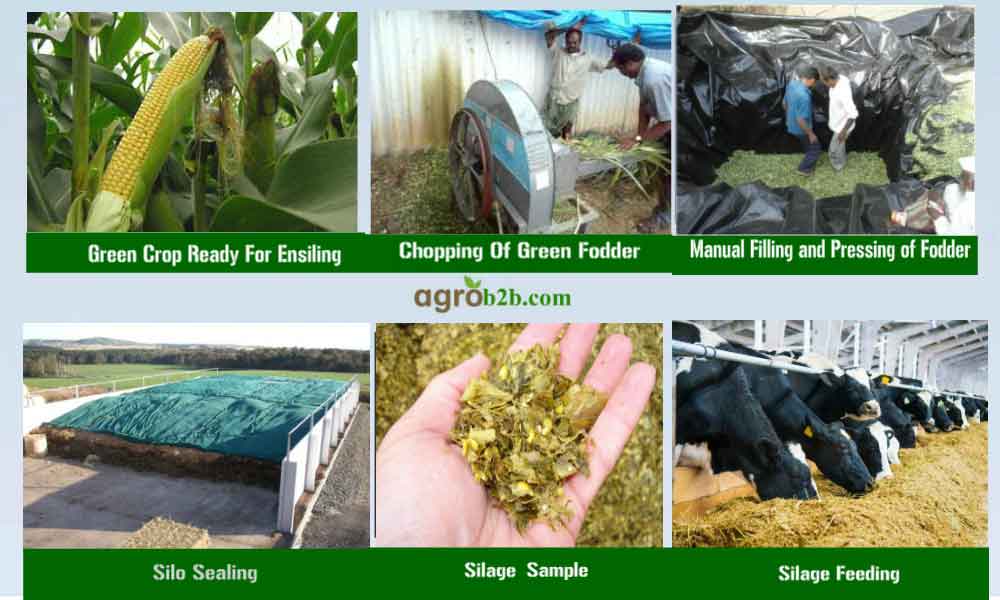
Ensilage has many advantages over the other methods for preservation of nutrients, particularly from forages. Nutrients from the forages have been preserved using acids for many years since ancient time. Silage is the materials produced by controlled fermentation of nutrients under an anaerobic condition. The process is referred to as ensiling. Ensiling of forage requires precautions for proper preservation of nutrients as lack of understanding of the factors associated with ensiling process may produce silage of poor quality leading to the poor animal performances. The fermentation process is governed by microorganism present in fresh herbage or by additives to maintain anaerobic conditions and discourage clostridial growth with minimum loss of nutrients. More recently, this process has been used to preserve carbohydrate rich materials, either alone or through fermentation with other materials, as well as storage of protein rich materials used as animals feeds (Machin, 1990).
Maturity of forage crop at harvest
Time of harvest has a major impact on the nutritive value of silage. Protein content, available energy, daily nutrient intake and digestibility decrease with advancing crop maturity (Mojumdar and Rakib, 1980), while later cutting represents lower carbohydrate and more lignin. Since dry matter yield per unit area are lowered by early harvest, time of harvest is a compromise between nutritive value and yield. High prices for energy and protein tend to favour early harvest despite of lower dry matter yield. Table 1 indicates the optimum stage of harvest of forage crops when nutrients are properly preserved.
Table 1. Recommended stage of harvest of forage crops
| Forage Crop | Stage of Harvest | Reference |
| Maize | 50%flowering to dough stage | Thakur and Sharma, 1998;
Mojumdar et al., 1999 |
| Sorghum | 50%flowering to dough stage | |
| Oat | Boot to dough stage | |
| Grasses | Early flowering |
Advantages/ disadvantages of ensiling over hay
The nutrients in the forages can be preserved as silage or hay. Silage has many advantages over hay and other methods of preservations, chiefly because of less loss of essential nutrients.
- Lower field losses particularly of leafy portion which is relatively rich in protein and minerals
- Lower probability of rain damage and thus leaching of nutrients
- Storage over longer period, if properly packed under optimal ensiling conditions
- Provide more succulent feed to livestock
- Ideal technology for preserving nutrients in temperate conditions
- Less dependence over weather conditions, particularly availability of sun lights
While disadvantages includes-
- Being mechanized technology, requires considerable capital investment
- Limits the preservation of high CP containing forages such as leguminous fodders e.g. cowpea, berseem, lucerne etc alone
- Losses of nutrients can be high if not properly preserved with exclusion of air and water. Clostridial fermentation spoils the quality of silage and its feeding value. Formation of butyric acid makes silage unpalatable.
- High moisture silage leads to greater seepage losses
- Less marketable
- Voluntary intake by animal is a limiting factor if acid production is high (Demarquilly, 1973)
- Must be fed as soon as possible after removal from silo to avoid secondary fermentation
- Chopping of forage is must otherwise good packing of silo is not possible and allows the air to be trapped which in turn allows mould formation
- Poor technical knowledge of storage
Ways to reduce nutrient losses
Reduction in the nutritive value of silage fermentation with respiratory losses, silage heating and clostridial fermentation is minimized by limiting air and moisture contact with silage (Bolsen et al, 1996). Minimizing oxygen exposure to silage is essential for obtaining good quality silage. Air allows the respiration process to continue using soluble carbohydrates essential for acid production, which generates heat and increases the temperature. Process of respiration results in loss of nutritionally valuable dry matter and energy. Air exposure during preservation tends to progress towards mould formation and leading to rotted silage. The increase in the temperature of silage as a result of heating also reduces its palatability when fed to livestock (Pelz and Hoffman, 1997). Uniformly compacted silage and properly sealing aids in air exclusion.
Dry matter concentration of the forages plays a vital role in minimizing the nutrient losses during ensilage. High moisture silage leads to effluent losses. Another disadvantage of high moisture silage is a clostridial fermentation, which leads to excessive dry matter losses, high butyric acid concentration and lower nutrient intake (Henderson and McDonald, 1971). Harvesting forages at the proper stage of the growth and dry mater content maximizes the nutritive value of silage (Mojumdar and Rekib, 1980). Wilting of high moisture forage to 30% dry matter is a safe way, which inhibits the clostridial fermentation. Clostridia bacteria degrade sugars and also convert lactic acid to butyric acid and elevate ammonia concentration and thus causing pH to rise. They also break down protein to amines. Thus, clostridial fermentation has an undesirable effect on the nutrient leading to their decomposition to undesirable end products, dry matter loss and reduced palatability (Nikolic and Jovanovic, 1986).
The heat caused during fermentation plays vital role in preservation of nutrients. Higher temperature silage (1000F) has been found to be poor in quality. The over heated silage produced at a temperature above 1200F have been found to be resulting into heat damaged protein having brown to dark brown colour with a tobacco type fowl smell. Protein of heat-damaged silage forms a complex with carbohydrates and is not digestible. The part of protein and energy is not available to livestock and resulting in to lower DCP and TDN values (Rodriguez et al, 1985). Higher temperature also increases aerobic spoilage and reduces stability of silage.
Water soluble carbohydrate content of forages constitutes the primary nutrient that is fermented to lactic acid and acetic acid by Lactobacillus bacteria to produce a low pH (4.5) and stable silage. Maize, sorghum, oat and other cereal fodders usually has higher soluble sugar (> 10%) concentration and a good stable silage having lactic acid as percent of total acid to the tune of 60 is obtained while tropical grasses and legume forages having low soluble sugar content are not frequently used to produce stable and good quality silage chiefly because of low lactic acid production mostly below 3% of dry matter (Singh and Rekib, 1986a). Carbohydrates in the forages may be naturally occurring or may be added as a separate ingredient such as molasses obtained as sugar industry by-products (Evers and Carrell, 1998), which act as a fermentable substrate. Relatively more lactic acid is produced from glucose present in the ensiling forage than fructose. Hemi-cellulose after acid hydrolysis produces pentoses, which is then fermented to lactic acid and acetic acid (Hendersan et al, 1979). An index has been developed on the basis of proportion of lactic acid, acetic acid and butyric acid for the grading of silage quality, which is chiefly governed, by the amount of lactic acid (Zimmer, 1971). Besides carbohydrates, the protein content of the ensiling forage plays an important role in determining the quality and feeding value of silage. High CP content in the leguminous forages leads to ammonia production during fermentation leading to rise in pH (5 and above), buffering action and temperature. The subsequent rise in temperature tends the protein to combine with carbohydrates making it indigestible. Silage thus produced is brown in colour and gives ammonical or tabbaco like odor (Yu and Thomas, 1976). The high moisture content (more than 75%) causes more protein loss due to proteolysis by clostridia. Nitrates present in the plant are reduced to nitrites which in turn release ammonia (Singh et al, 1983).
Additives for effective ensiling of nutrients
Various types of additives can be used to improve or inhibit the fermentation or supplement nutrients needed by ruminants to be fed as silage. Adding acids such as sulfuric acid, formic acid and other acids decreases the pH of the forage ensiled and helps to preserve it. But corrosiveness of these acids is the limiting factor for their use. Propionic acid reduces aerobic deterioration, heating and mould formation at the top of silage layers. The use of acids has also financial implications for the economic viability of their use. Formaldehyde has been used for effective preservation as it inhibits the fermentation. Addition of formaldehyde @ 5.0 litre per ton of fresh maize fodder has been found to produce good quality silage with higher feeding value when fed to cross-bred calves (Verma and Mojumdar, 1984). Addition of formaldehyde has also been reported to improve the DMI when fed to ruminants (Barry et al., 1973). Forages with marginal concentration of soluble carbohydrate may benefit from enzymes such as cellulase, pectinase and amylase that can break down complex plant structural carbohydrates such as cellulose, pectin and starch present in forage to simple sugar which then can be fermented to lactic acid. McHan (1986) reported increase in water soluble carbohydrate in cellulase and hemi-cellulase treated silage. An increase in soluble sugar content resulted in more lactic acid (10%) and lower ammonia-N (less than 6% of total nitrogen) and pH 4.5 in enzyme treated silage (Van Vauren et al., 1989). Commercial bacterial inoculants have also been used in developed countries which increase the rate of lactic acid fermentation and produce stable silage but such system may not be profitable.
Carbohydrate sources such as molasses, whey, yeast and other energy rich ingredients, have also been used as additives to increase the fermentation and feeding value of silage. Most commonly used carbohydrate sources are molasses which is used to add fermentable sugars to forage low in sugar. It can be added @ 5-10% depending upon the sugar content of ensiling forage. Urea is the most important source of non-protein nitrogen used to elevate CP content of cereal forage silage low in protein. Addition of urea @ 0.5-1.0% has been found to increase CP content and lactic acid content of silage (Verma et al., 1982, Singh and Rekib, 1986b). Nutritive value, particularly CP content of graminaceous forage silage can be improved by mixing legumes forages such as cowpea, berseem and Leucaena leucocephela leaves (Verma and Mojumdar, 1985, Mojumdar et al., 1980).
Nutrient losses during ensilage
Generally, loss of dry matter, carotenes, carbohydrate and proteins occur due to respiration, fermentation and aerobic deterioration. The other losses of nutrients arise from field, harvesting and affluent losses. The field losses may occur due to shattering of leaves and other nutritious portions because of poor harvesting managements. The extent of loss during dry matter depends on the time for which the forage is ensiled quickly, the respiration losses are negligible. Over the period of 48 hours, losses of DM may occur which may be as high as 6.4 percent after 5 days. Loss of carbohydrates and protein also occur due to respiration and proteolysis by plant enzymes. Several studies have been revealed that the loss of nutrients during ensilage was drastically minimized with increasing dry matter content of ensiling material (Honig, 1968). The fermentation losses chiefly depend upon the moisture content. The clostridial type fermentation is deleterious for most of the nutrients. The clostridia are responsible for the loss of protein. Losses thus are dependent upon pH, moisture content of ingoing material and type of micro-organism growing during course of fermentation. Forages of low dry matter content (less than 22.9%) leads to effluent production with a considerable loss of nutrients (Castle and Watson, 1973). Haigh (1999) observed positive relationship between moisture content of ensiled forage and effluent production. This could be minimized by wilting. The high moisture herbages preserved with the use of additives such as formic acid, sulfuric acid and formaldehyde to inhibit or manipulate the fermentation has been found to increase effluent production. After the silo is opened for feeding to livestock, the silage surface is exposed to air and thus leading to aerobic secondary fermentation. During aerobic degradation, the temperature and pH rises while lactic acid content reduces. Loss of DM and nitrogenous substances occur due to escape of volatile fatty acid, lactic acid and ammonia. Loss of nutrients arising out of secondary fermentation could be 0-15% and could be minimized by management practices such as use of cover, propionic acid etc (Wyss, 2000). The Table 2 below summaries the losses of nutrients during preservation of herbages as silage.
Table 2. Nutritive losses during ensilage
| Biological process | Judgment | Approx loss (%) |
| Respiration | Unavoidable | 1-2 |
| Fermentation | Unavoidable | 1-4 |
| Effluent | Mutual | 5-7 |
| Pre-wilting | Unavoidable | 2-5 |
| Secondary fermentation | Avoidable | 0-5 |
| Aerobic transformation | Avoidable | 0-15 |
| Total losses | 7-35 |
Source: Zimmer 1971
Nutritive value of silage
Voluntary intakes of silage has been a limiting factor and lower than that of green forage (Pachauri and Mojumdar, 1994) which is more prevalent with high moisture silage. The main reason of low intake could be ascribed to low pH and high lactic acid content. Wilting has been reported to increase intake of silage considerably (Singh and Rekib, 1986b). Use of formic acid as additive has been reported to increase intake, body weight gain as well as milk production (Waldo and Derbyshire, 1971; Castle and Watson, 1970). Nutritive value of cereal forages can be improved by supplementing them with 0.5% urea or mixing with either leguminous forages such as cowpea or berseem (Upadhayay et al., 1983, Mojumdar et al., 1980) or with top feeds such as Leucaena leucocephala (Upadhayay and Mojumdar, 1991). Nutritive values of promising silages are presented in Table 3.
Table 3. Nutritive value of silages
| Forage material | Ratio
(%) |
CP
(%) |
DM
(%) |
DCP
(%) |
TDN
(%) |
DMI
(% b.wt.) |
| Sorghum PC-6 | – | 4.94 | 35.0 | 5.98 | 56.6 | 2.25 |
| Hy. Napier NB-21 | – | 4.30 | 51.5 | 0.9 | 54.1 | 2.67 |
| Hy. Napier + sesbania | 3:1 | 7.10 | 53.2 | 3.9 | 54.7 | 2.76 |
| Maize + formaldehyde | 0.5% | 10.10 | 56.9 | 5.9 | 55.5 | 2.56 |
| Maize + C. ciliaris | 3:1 | 6.10 | 46.3 | 1.8 | 43.7 | 1.97 |
| Maize + 1% urea | – | 12.5 | 43.7 | 7.7 | 45.4 | 1.30 |
| Maize + cowpea | 1:1 | 12.6 | 69.4 | 8.4 | 64.1 | 2.86 |
| Berseem + paddy straw | 1:5 | 7.40 | 47.6 | 3.0 | 46.2 | 2.42 |
| Berseem + dry grass | 1:5 | 4.00 | 52.6 | 1.4 | 54.4 | 2.37 |
| Berseem + sorghum straw | 1:5 | 5.70 | 59.5 | 3.8 | 56.4 | 2.56 |
| Berseem + oat | 1:1 | 14.3 | 51.8 | 6.7 | 56.4 | 2.88 |
| Lucerne + wheat straw | 2:1 | 8.10 | 53.1 | 5.1 | 50.9 | 2.95 |
Source: Rekib and Singh, 1988
REFERENCES
Bala Peeraiah, K., Prabhakar Rao and Anjaneya Prasad D. 1993. Sesbania as replacement for groudnut cake in complete diets in sheep. Indian J. Anim. Nutr., 10 : 95-98.
Barman, K. and Rai, S.N. 2003. Comparative evaluation of cotton seed cake and LLM on profiles of amino acids, tannins and digestive kinetics. Indian J. Anim. Nutr., 20 : 378-388.
Barry, T.N, Fennesy, P. F. and Duncans, S.J. 1973. Effect of formaldehyde treatment on the nutritive value of silage. New Zealand J. Agric. Res., 16 : 64-68.
Bolsen, K.K., Ashbell, G. and Weinberg, Z.G. 1996. Silage fermentation and silage additives review. Asian Australasian J. Anim. Sci., 9 : 483- 493.
Butler, G.W and Bailey, R.W. 1973. Chemistry and Biochemistry of Herbage. Academic Press, New York.
Castle, M.E. and Watson, J.N. 1993. The relationship between the dry matter content of herbage for silage making and effluent production. J. Br. Grassland. Soc., 28 : 135-138.
Changjun B., Guodao, L, Wong, D, Prasad, V.L.K, Ramesh, C.R and Gopalam, A. 2004. Stylosanthes leaf meal for animal industries in china and India. ACIAR Report, Canberra, 243-252.
D’ Mello, J.P.F and Fraser, K.W. 1981. The composition of leaf meal from Leucaena leucocephala. Tropical Sci., 23 : 75-78.
Demarquilly, C. 1973. Chemical composition, fermentation characteristic, digestibility and voluntary intake of forage silage. Annales de Zootechnic, 22 : 1-10.
Evers, D.J. and Carroll, D.J. 1998. Ensiling salt-preserved waste with grass straw and molasses. Anim. Feed. Sci. Technol., 61 : 241-249.
Garcia, G.W., Fergusan, T.V., Neckles, FA and Arlchibsand K.A.E. 1996. The nutritive value and forage productivity of Leucaena leucocephala. Anim. Feed Sci Technol., 60 : 29-41.
Garg, M.C and Kumar, S. 1994. Effect of replacement of oil cake protein in concentrate mixture by LLM on nutrient utilization and milk yield in Murrah buffaloes. Indian J. Anim. Nutr., 11 : 43-46.
Haigh, P.M. 1999. Effluent production from grass silage treated with additives and made in large-scale silos. Grass and Forage Science, 54 : 208-218.
Honig, H. 1968. Die volkenroder bilangaulage. Seigene Futter, 14 : 304-315.
Hendersan, A.R. and Mc Donald, P. 1971. Effect of formic acid and the fermentation of grass of low dry matter content. J. Sci. Fd Agric., 22 : 152-163.
Henderson, A.R., Ewart, J.M and Robertson, G.M. 1978. Studies on the aerobic stability of commercial silage. J. Sci. Fd Agric., 30 : 223-228.