



The Silent Pandemic: Antimicrobial Resistance Through the One Health Lens
Dr. Jasanjot Singh* and Dr. Karuna P. Bambode**
* Department of Veterinary Physiology, GADVASU Ludhiana (Punjab
** Scientist, Division of Animal Physiology, ICAR-NDRI, Karnal-132001 (Haryana))
Abstract
Antimicrobial resistance (AMR) represents a significant and growing threat to human health, animal health, and the sustainability of our environment. The increasing inability of antibiotics and other antimicrobial agents to control infectious diseases jeopardizes livestock production, food security and public health. The One Health approach recognizes that resistant microorganisms move among people, animals and the environment, requiring integrated solutions. This article discusses the causes of AMR, its impact on veterinary practice and farming systems, transmission pathways, stewardship strategies and practical interventions for disease prevention. Strengthening biosecurity, vaccination, surveillance and responsible antimicrobial use can help preserve the effectiveness of life‑saving medicines for future generations.
Keywords
Antimicrobial resistance, One Health, livestock, public health, veterinarians, antibiotic stewardship, food safety
Introduction
Antimicrobial resistance is often called the silent pandemic because it develops gradually but has profound consequences. Antibiotics revolutionized medicine and animal husbandry by enabling effective treatment of bacterial infections. However, decades of inappropriate and excessive use have accelerated the emergence of resistant microorganisms. Today, resistant pathogens threaten treatment success in hospitals, veterinary clinics and farms worldwide.
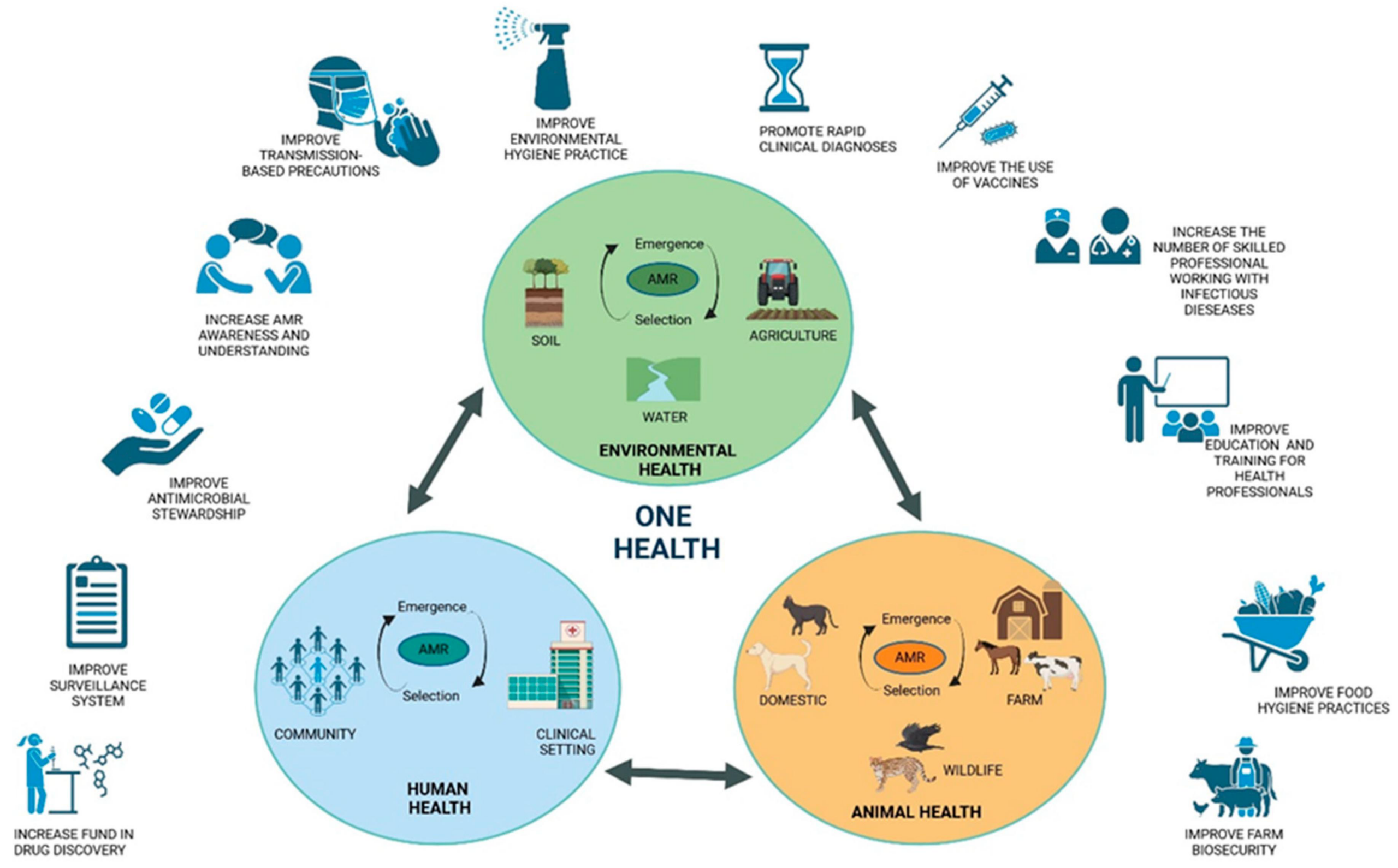
The One Health concept emphasizes that human, animal and environmental health are interconnected. Resistant bacteria originating in one sector can spread to another through direct contact, food, water, wildlife and environmental contamination. Therefore, AMR cannot be addressed by physicians or veterinarians alone. It requires coordinated action involving farmers, public health professionals, scientists, policymakers and consumers.
Understanding Antimicrobial Resistance
What Are Antimicrobials?
Antimicrobials are a broad group of agents used to prevent and treat infections caused by different types of microorganisms. This group includes antibiotics, which target bacteria; antivirals, which act against viruses; antifungals, which combat fungal infections; and antiparasitic drugs, which address parasites. Together, these medications are essential for maintaining the health of humans and animals by controlling infectious diseases.
How Does Resistance Develop?
Antimicrobial resistance occurs when microorganisms develop the ability to survive exposure to drugs that were once effective against them. This process happens as microorganisms adapt and evolve over time. When antimicrobials are used inappropriately—such as when they are given without proper diagnosis, administered in incorrect doses, or used too frequently—natural selection favors those microbes that can resist the effects of these agents. As a result, resistant strains multiply and spread, gradually reducing the effectiveness of available treatments.
One Health and the AMR Challenge
AMR perfectly illustrates the importance of the One Health framework. Humans, animals and ecosystems are linked through numerous biological and environmental pathways.
In human medicine, resistant infections increase morbidity, mortality and healthcare costs. In veterinary medicine, resistance compromises treatment of mastitis, respiratory diseases, enteric infections and other economically important conditions. Environmental reservoirs, including soil and water contaminated with resistant bacteria and antimicrobial residues, facilitate persistence and dissemination of resistance determinants.
A One Health approach promotes collaboration among sectors to identify risks, monitor resistance patterns and implement coordinated interventions.
AMR in Livestock Production
Livestock play a crucial role in food security and rural livelihoods. Farmers rely on healthy animals for milk, meat, eggs and income. Antimicrobials are valuable tools for maintaining animal welfare when used appropriately. Problems arise when drugs are administered without diagnosis, used as substitutes for management improvements or applied inconsistently.
In dairy production, mastitis remains a leading reason for antimicrobial use. In poultry and pig production, respiratory and enteric diseases may also prompt treatment. Repeated exposure to antibiotics can select resistant bacteria, reducing future treatment effectiveness.
Responsible use requires veterinary oversight, laboratory diagnosis when feasible and adherence to recommended dosages and withdrawal periods.
Transmission Pathways
Resistant microorganisms are capable of moving between animals, humans, and the environment through several distinct pathways. One notable route is direct contact, where farm workers interacting closely with animals may acquire resistant organisms. Another significant pathway involves contaminated food products; when resistant bacteria are present in food, they can enter the food chain and pose risks to human health.
Additionally, manure and wastewater generated on farms can carry both resistant microorganisms and antimicrobial residues, which may subsequently disseminate into soil and aquatic ecosystems. These interconnected pathways highlight the complexity of antimicrobial resistance transmission and reinforce the importance of coordinated interventions across human, animal, and environmental health sectors.
Economic and Public Health Consequences
AMR carries significant economic costs. Farmers may face reduced productivity, prolonged illness, increased treatment expenses and greater mortality. Resistant infections can necessitate the use of more expensive medicines and additional veterinary interventions.
From a public health perspective, treatment failures contribute to longer hospital stays, increased healthcare expenditure and elevated mortality risk. Food systems may also be affected if consumer confidence declines due to concerns about antimicrobial misuse and resistance.
Role of Veterinarians
Veterinarians are central to antimicrobial stewardship. Their responsibilities extend beyond prescribing medicines. They assess disease risk, implement preventive programs, guide vaccination schedules, improve biosecurity and educate farmers regarding prudent antimicrobial use.
Evidence‑based prescribing helps ensure that antimicrobials are used only when necessary. Veterinarians also contribute to surveillance systems by monitoring disease trends and resistance patterns. Through extension activities and farmer training, they promote sustainable livestock production practices.
Practical Strategies for Farmers
Farmers are indispensable partners in combating AMR. Disease prevention remains the most effective strategy for reducing antimicrobial dependence.
Key interventions include:
• Maintaining strict biosecurity.
• Purchasing animals from reliable sources.
• Ensuring adequate nutrition and clean water.
• Implementing vaccination programs.
• Improving housing, ventilation and sanitation.
• Isolating sick animals promptly.
• Keeping accurate treatment records.
• Following veterinary advice regarding antimicrobial use.
Good management improves productivity while reducing disease incidence and antimicrobial consumption.
Conclusion
Antimicrobial resistance threatens the foundations of modern medicine, veterinary practice and food production. Because resistant microorganisms move among people, animals and ecosystems, AMR is fundamentally a One Health challenge. Veterinarians and farmers occupy key positions in safeguarding antimicrobial effectiveness through responsible use, disease prevention and biosecurity. By embracing integrated One Health strategies, society can slow the spread of resistance, protect public health and ensure sustainable livestock production for future generations.
References
- Food and Agriculture Organization, United Nations Environment Programme, World Health Organization and World Organisation for Animal Health (2022). One Health Joint Plan of Action (2022–2026): Working together for the health of humans, animals, plants and the environment.
- McEwen, S.A. and Collignon, P.J. (2018). Antimicrobial resistance: A One Health perspective. Microbiology Spectrum. 6(2):1‑26.
- Robinson TP, Bu DP, Carrique-Mas J, Fèvre EM, Gilbert M, Grace D, Hay SI, Jiwakanon J, Kakkar M, Kariuki S, Laxminarayan R, Lubroth J, Magnusson U, Thi Ngoc P, Van Boeckel TP, Woolhouse ME. Antibiotic resistance is the quintessential One Health issue. Trans R Soc Trop Med Hyg. 2016 Jul;110(7):377-80. doi: 10.1093/trstmh/trw048.
- Van Boeckel TP, Brower C, Gilbert M, Grenfell BT, Levin SA, Robinson TP, Teillant A, Laxminarayan R. Global trends in antimicrobial use in food animals. Proc Natl Acad Sci U S A. 2015 May 5;112(18):5649-54. doi: 10.1073/pnas.















